So Cain went out from the Lord’s presence and lived in the land of Nod, east of Eden. Cain made love to his wife, and she became pregnant and gave birth to Enoch. ~ Genesis 4:16-17
Where did Cain’s wife come from?
It’s a fair question, one that’s been asked and debated for a long, long time — even, as I understand it, figuring into the testimony of the Scopes “monkey” trial and a mention in the plotline of Carl Sagan’s Contact.
Genesis 1:1-2:3 tells an epic story of creation, culminating with the forming of mankind, male and female, and God resting on that note of triumph.
Genesis 2:4ff, I believe, backs up to the third day of creation, when God formed a first man, a specific man, Adam – with the purpose of caring for the plants and animals of a garden He had planted east of Eden. When Adam yearned for companionship, He formed Eve from Adam’s rib (containing his perfect DNA and all the potential for great diversity — a guess on my part, given the reported age of many of those early patriarchs).
The sad story of what happened next — well, I’ve blogged about that before, and I’ve explained there why I believe this part of the story takes place beginning at that third day: because scripture takes great care to explain the conditions present. Nothing is said about animals at that point, so in the days that come, they are added: birds and fish on the fourth day; creatures that crawl on the earth the fifth.
Then four days after Adam’s creation — on the sixth day — God created many more people, mankind, and told them to be fruitful and multiply and fill the earth.
But Adam and Eve had a specific task and calling: to make a choice between obeying and disobeying God. Possibly He created more people — “mankind,” as some versions of the Bible render the word — because that perfect DNA given Adam and Eve had been corrupted by the fruit of disobedience and the genes for death … and could no longer provide the diversity needed to sustain the species.
Mankind was given the task of reproduction, providing progeny.
And this is where I give a nod to Cain and his wife, who hailed from among the people of the land of Nod. Perhaps those people were some of the “mankind” God created.
Those who told the story generations later would likely have had the same distaste for incest that we do. (Think about the dishonorable context of the account of Lot and his daughters later in Genesis.) That — in addition to the possibility of DNA damaged by sin and its byproduct death — makes it unlikely that Cain’s wife would have been his sister; another child of Adam and Eve. (And peculiarly, no one ever asks where Seth procured a wife, though he had a son named Enosh. I’m betting he didn’t bear the child himself.)
Immediate scripture doesn’t say anything about another child of theirs beyond Seth — which doesn’t preclude the possibility that she was theirs, but still seems odd. Genesis 5:4 does says that they were parents of “sons and daughters,” but does not make a connection to the spouses of their named sons.
As a story, I find the entire Genesis account consistent within itself, rather than two separate inconsistent accounts. The inconsistency, I’m persuaded, is our misreading the timing and identity of the characters and their days of inception: Adam on the third day and possibly Eve soon after; mankind on the seventh.
I know that a good number of well-intentioned people have predicated the answer that Cain’s wife was his sister or near-kin from the conclusion that all people descended from Adam and Eve. But that is a conclusion, and not something that scripture specifically says. We are of one blood (the NIV inaccurately translates Acts 17:26 as saying “of one man”), but that does not necessarily imply a single common ancestral pair.
In fact, to draw upon the consistency of the story, it could be argued that the bloodlines of “mankind” were destroyed in the flood in which Noah — a descendant of Adam and Eve — and his family were saved. And it may be that the “sons of God” referred to in Genesis 6:4 refer to the descendants of that special Adamic bloodline.
Once again, I must post a disclaimer that third-day Adamic creation is a theory; it is speculation; it has its strong and weak points. But after years of pondering it, this possibility makes more sense than the others I have read to explain some of the difficulties in the creation narrative of the Bible, and continues to refute the criticisms that there inconsistencies which render its story invalid.
The Bible doesn’t fill in the details of everything we want to know. It does, however, often hint at answers that we can seek to discern and discuss, and grow spiritually by doing so.
 It was time for a new set of flowers at Angi’s grave. I brought a yellow rose (her favorite) each for Matt, Laura and her mom, Harriette. The little white silk flowers are from me. They remind me of the baby’s breath in her wedding bouquet.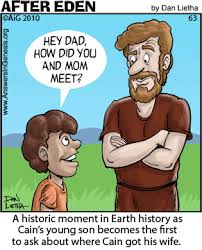
 Blog In My Own Eye