Harding University and Her New President

It seems like everyone who blogs and is my age or younger and attended there has an opinion about the choice of Bruce McLarty as the new president of Harding University, or about the institution’s direction or mission or future.

I can’t say that I really do.

I wish the University well and Bruce McLarty well and that’s just about it.

Sorry if that violates hopes or expectations.

I am grateful for the fine education I was offered and received at Harding from 1973-1977; for the wonderful friends I met and made there; for the experiences one cherishes for a lifetime.

But I must confess I was never really comfortable there.

I think I was too young to perceive the politics or religious convictions attached to the university then, but I was not too young to perceive that a little freedom was regarded as a dangerous thing.

From the way the dorms were locked and bed-checked at night (some without fire doors back then) to the ominous restrictions on attire, decor and behavior, it was pretty obvious that deviation from a well-described norm would not be tolerated. Individualism would be frowned upon. Self-expression would be patrolled.

I’m sure that many of these restrictions have been removed, loosened, or modified to become more socially-acceptable in modern society.

But Harding and I have gone separate ways, and awkwardly since I vacated my dorm room. We have an unspoken deal: They don’t send me any alumni publications or e-mails, and I don’t send them any money, children, or home addresses.

Mostly because, at the heart of it, I think that a really excellent education requires a little bit more freedom for students and trust in their ability to think, provide, and act for themselves than I could have ever hoped to experience there at that time.

That made it, in some ways, a very long four years. Back then – as I’ve shared before – Harding’s motto was “Educating for Eternity.” And one of my roommates observed, “It’s really just four or five years. It just seems like an eternity.”

Acts 9

I preached for the first time this morning at my new home church, Sylva Church of Christ. In fact, it was the first time I’ve preached in five years! A friend asked if I’d post my notes, but I didn’t write any beforehand. In fact, I asked my church family this morning that if I couldn’t do this from memory, how could I expect them to remember it? But this is what I remember saying and reading (or at least preparing to say):

Good morning and thanks for coming this morning, especially if you heard in advance that I was going to speak. And a very happy Veteran’s Day. If you served, thank you for your service to our country. I don’t know whether you were conscripted or volunteered, but this morning we’re going to talk about how the Lord recruited one of the great soldiers of the cross, Saul of Tarsus.

If you’re visiting with us, our church family’s study of the book of Acts of the Apostles has brought us to chapter nine. But first, to set the stage, we have to roll back to chapter eight. Luke is writing his two gospels in what I believe to be chronological order, so to us he seems to skip from one subject to another. Two weeks ago, Jonathan Wade shared with us a lesson from the stoning of Stephen, which ends with these words:

And Saul was there, giving approval to his death.

On that day a great persecution broke out against the church at Jerusalem, and all except the apostles were scattered throughout Judea and Samaria. Godly men buried Stephen and mourned deeply for him. But Saul began to destroy the church. Going from house to house, he dragged off men and women and put them in prison.

Then Luke tells us what happened with Philip, and that provided last week’s lesson from chapter eight. But we pick up with the church in trouble, in chapter nine, verse 1:

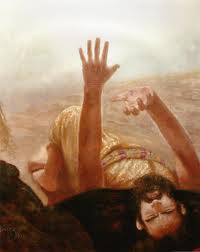
Meanwhile, Saul was still breathing out murderous threats against the Lord’s disciples. He went to the high priest and asked him for letters to the synagogues in Damascus, so that if he found any there who belonged to the Way, whether men or women, he might take them as prisoners to Jerusalem. As he neared Damascus on his journey, suddenly a light from heaven flashed around him. He fell to the ground and heard a voice say to him, “Saul, Saul, why do you persecute me?”

“Who are you, Lord?” Saul asked.

“I am Jesus, whom you are persecuting,” he replied. “Now get up and go into the city, and you will be told what you must do.”

The men traveling with Saul stood there speechless; they heard the sound but did not see anyone. Saul got up from the ground, but when he opened his eyes he could see nothing. So they led him by the hand into Damascus. For three days he was blind, and did not eat or drink anything.

10 In Damascus there was a disciple named Ananias. The Lord called to him in a vision, “Ananias!”

“Yes, Lord,” he answered.

11 The Lord told him, “Go to the house of Judas on Straight Street and ask for a man from Tarsus named Saul, for he is praying. 12 In a vision he has seen a man named Ananias come and place his hands on him to restore his sight.”

13 “Lord,” Ananias answered, “I have heard many reports about this man and all the harm he has done to your saints in Jerusalem. 14 And he has come here with authority from the chief priests to arrest all who call on your name.”

15 But the Lord said to Ananias, “Go! This man is my chosen instrument to carry my name before the Gentiles and their kings and before the people of Israel. 16 I will show him how much he must suffer for my name.”

17 Then Ananias went to the house and entered it. Placing his hands on Saul, he said, “Brother Saul, the Lord—Jesus, who appeared to you on the road as you were coming here—has sent me so that you may see again and be filled with the Holy Spirit.” 18 Immediately, something like scales fell from Saul’s eyes, and he could see again. He got up and was baptized, 19 and after taking some food, he regained his strength.

Some things worth noting: Damascus was something of a travel hub to the rest of the Roman empire from Jerusalem. Saul was a strategic thinker. He probably thought that the place to stop the spread of this new threat to his religion was the place where the believers would likely go after the persecution that began on the day he watched the coats for Stephen’s execution. Instead, the Lord put a stop to Saul.

(If you missed our Halloween trunk-or-treat, Russ Seagle answered the call to dress like a person or thing from Acts by becoming Saul, and taking our coats in exchange for a coat-check slip.)

A light from heaven strikes Saul blind, but the men with him could see no one; they hear a sound, yet (as Saul-renamed-Paul tells us in chapter 22, verse 9) couldn’t understand it as a voice. So there was really only one witness to what happened here.

(By the way, I hope you like this story, because if we continue to study Acts, we’ll hear it two more times as Paul retells it to a hostile crowd in Jerusalem in chapter 22 and to King Agrippa and Governor Festus in chapter 26.)

Saul sees a light, and hears Jesus. He falls to the ground. A few years ago, I did a little study of scripture and discovered that most of the time, when people encountered God face-to-face, they fell to their knees and sometimes on their faces. I made a commitment at that time to kneel when I pray — you may have noticed me doing it, and I hope it doesn’t disturb you — but it’s my reminder that Whom I’m talking to is the almighty God who created all things, yet is as close as our hearts are willing to draw near to Him.

Saul is struck blind, and the Lord lets him stew about it for three days. Just about the amount of time it takes to get from a cross to the garden outside an open tomb, coincidentally. That had to be frustrating for him. We’re told he didn’t eat or drink those three days of his entombment in darkness. I’ll bet he was fasting. He was a Jew of Jews, and it was the custom to fast while praying. You hardly ever read about fasting in scripture unless prayer is in the same verse, or as in this case, just a couple of verses away. Saul had a lot to fast and pray about.

Don’t you imagine he was praying: “Lord, I didn’t know! I thought I was doing the right thing for You! Please – what can I do to undo the suffering I’ve caused?” But there wasn’t anything he could do to make that wrong right. Jesus alone could, and did, all that could be done. Saul wasn’t ready to hear that yet.

Did you notice that Ananias was told that the Lord would show Saul “how much he must suffer for my name” rather than “how much he will accomplish in my name”? Saul was still steeped in the law, an expert in the fact that sin has consequences. Learning that he would suffer might have even given him some comfort at this point. He wasn’t yet ready for grace. We learn much of what we know about God’s grace from the pen of Saul, later named Paul. But not yet.

And what about Ananias? He had every reason to be frightened about what the Lord told him to do. But he did it. He went right to the house on Straight Street, put his hands on Saul’s shoulders, and called him “Brother Saul.” He had already accepted Saul as a brother. Ananias lived up to his name, which means: “Grace from God.”

So that brings me to the first of three simple points I’d draw from this chapter:

Sometimes God calls people.

Noah comes to mind. Abram and Sarai. Moses. Samuel. Isaiah. Jeremiah. Mary, the mother of Jesus. Each has a moment to bow in awe before God and an opportunity to do what God asks, whether it’s large and lifelong like Saul … or small and short, like Ananias. Except for Paul retelling this in chapter 22, we don’t hear about Ananias again. But what he was called to do was important.

Let’s get back to the text in the last part of verse 19:

Saul spent several days with the disciples in Damascus. 20 At once he began to preach in the synagogues that Jesus is the Son of God. 21 All those who heard him were astonished and asked, “Isn’t he the man who raised havoc in Jerusalem among those who call on this name? And hasn’t he come here to take them as prisoners to the chief priests?” 22 Yet Saul grew more and more powerful and baffled the Jews living in Damascus by proving that Jesus is the Christ.

23 After many days had gone by, the Jews conspired to kill him, 24 but Saul learned of their plan. Day and night they kept close watch on the city gates in order to kill him. 25 But his followers took him by night and lowered him in a basket through an opening in the wall.

26 When he came to Jerusalem, he tried to join the disciples, but they were all afraid of him, not believing that he really was a disciple. 27 But Barnabas took him and brought him to the apostles. He told them how Saul on his journey had seen the Lord and that the Lord had spoken to him, and how in Damascus he had preached fearlessly in the name of Jesus. 28 So Saul stayed with them and moved about freely in Jerusalem, speaking boldly in the name of the Lord. 29 He talked and debated with the Grecian Jews, but they tried to kill him. 30 When the brothers learned of this, they took him down to Caesarea and sent him off to Tarsus.

31 Then the church throughout Judea, Galilee and Samaria enjoyed a time of peace. It was strengthened; and encouraged by the Holy Spirit, it grew in numbers, living in the fear of the Lord.

There’s no indication in scripture that anyone ever preached a gospel sermon to Saul. I’m guessing he already knew what the believers believed; what they did when they believed (because he was baptized). He was a sharp fellow; studied under Gamaliel. Probably was ready to prosecute the cases he was prepared to bring back to Jerusalem. And wouldn’t you guess that almost every time Saul dragged a believer off to jail, he got a sermon from them?

“Saul, how can you not believe? Don’t you see that Jesus’ life fulfills Isaiah 53? His death fulfills Psalm 22?”

The wonder is that Paul begins preaching right away. It’s almost like he can’t help himself; he has to preach! He can’t wait to start doing what he can to un-do the damage he’s done. His audience is confused; isn’t this the one who opposed the Way? — And isn’t that a wonderful name for the believers to be known by back in verse two? Jesus described Himself as the Way, the Truth and the Life … now with His Spirit in them, they are that “Way.”

He’s so good at this preaching, that no one can argue with him. So they do what has become the new normal; instead of responding in penitence, they try to kill him. Saul has to be sneaked out of the city away from the assassins in a basket let down from the city wall.

(That, by the way, was Jonathan’s costume from Acts: a brick-colored sweater and a necklace made of a little basket with a toy army man in it, standing in for Saul. He was the Wall of Damascus.)

Does that remind you of something from the Old Testament? It took me back to the story of Princess Michal, who let her husband David down through a window when her father the king was trying to kill him. And her father’s name was … yes, Saul. One of those little ironies of scripture that I find fascinating.

Verse 23 says that it was “after many days,” and it could have been a significant part of the three years that Paul mentions later in Galatians 1:18. “After many days,” Saul came to Jerusalem, where you’d think he’d be wanted by the high priest and charged with dereliction of duty at the very least, and he tried to join the disciples. Like Ananias, they were understandably scared of him. I’d have been afraid he was a kind of double agent, trying to infiltrate the ranks of believers in order to learn who they were so he could arrest them. I’m scared of speaking up; I worry: “Will it cost me my job? Harm my family? Ruin my reputation and influence?”

But not Barnabas.

Barnabas was willing to stick up for Saul. That brings me to the second point I’d draw from this chapter:

Sometimes God lets people perceive the need and step up to the plate.

You’ll find a lot of people like that in scripture, too: Miriam follows baby Moses in the basket down the river and reunites him with his mother … Deborah, Israel’s judge, becomes a military leader … Nehemiah longs to rebuild Jerusalem’s wall … Esther places herself in danger to speak up for her people, threatened with racial extinction. You can probably think of dozens more. They all saw the need, stepped up to the plate, and did what had to be done.

That’s what Barnabas did. He lived up to his name, which means “Son of Encouragement.” He put himself on the line. Can you imagine how much more difficult it would have been for Saul to do the work that the Lord had in mind for him if the apostles had not been on board with it? Barnabas introduced Saul to them, and told them what Saul had been doing in Damascus. To their credit, they took him in. And Saul went right back to doing what he couldn’t keep himself from doing: talking to anyone he could about Jesus. This ran him afoul of the Grecian or Hellenized Jews, who found they couldn’t win an argument with him and they, too, wanted to kill him. Once again, he has to be sneaked out and shipped off, this time to Tarsus, his hometown and a place where people knew him — as well as a place remote enough that it would be difficult to track him there to kill him.

But that last verse in this section serves as a counterpoint to chapter eight, verse three. The church rests from persecution for a while, and grows in strength and numbers. It says they lived in the fear of the Lord, and I don’t have a problem with the word “fear;” I think it means more than respect. God is a loving and merciful God, but He is also a just and righteous God who hates sin and will ultimately destroy it. You don’t want to be standing too close to sin when that happens.

Now Luke switches gears and locations and tells us another story in the order it happened, and it’s about Peter; let’s pick up in verse 32:

32 As Peter traveled about the country, he went to visit the saints in Lydda. 33 There he found a man named Aeneas, a paralytic who had been bedridden for eight years. 34 “Aeneas,” Peter said to him, “Jesus Christ heals you. Get up and take care of your mat.” Immediately Aeneas got up. 35 All those who lived in Lydda and Sharon saw him and turned to the Lord.

36 In Joppa there was a disciple named Tabitha (which, when translated, is Dorcas), who was always doing good and helping the poor. 37 About that time she became sick and died, and her body was washed and placed in an upstairs room. 38 Lydda was near Joppa; so when the disciples heard that Peter was in Lydda, they sent two men to him and urged him, “Please come at once!”

39 Peter went with them, and when he arrived he was taken upstairs to the room. All the widows stood around him, crying and showing him the robes and other clothing that Dorcas had made while she was still with them.

40 Peter sent them all out of the room; then he got down on his knees and prayed. Turning toward the dead woman, he said, “Tabitha, get up.” She opened her eyes, and seeing Peter she sat up. 41 He took her by the hand and helped her to her feet. Then he called the believers and the widows and presented her to them alive. 42 This became known all over Joppa, and many people believed in the Lord. 43 Peter stayed in Joppa for some time with a tanner named Simon.

Tabitha is yet another example of someone who saw a need and stepped up to the plate, and met the need. She brings me to the third and last point that I draw from this chapter:

No act of kindness or service is too small to glorify God.

Tabitha didn’t have a huge ministry that required a board of directors or tax advantages or donation robo-callers. It probably took a lot of her time, her hands, and her heart. She made clothes for widows and helped the poor. She took Jesus at His word when He asked us to look after the poor. And it meant the world to them. If she hadn’t been who she was, she wouldn’t have been loved and missed so much when she died — and what was done through Peter in bringing her back to life wouldn’t have had near the impact. The verses here say that “many believed.”

Tabitha may have been the closest thing to Jesus living in Joppa, and there she was, live as ever after being sick and dead, a living testament to Jesus’ power to bring life to those without one. Tabitha’s Jewish name and her Greek name, Dorcas, meant “gazelle,” an animal known for its beauty, grace and speed. Her name probably brought to mind to her Jewish friends the words of Isaiah 52:7:

How beautiful on the mountains are the feet of those who bring good news, who proclaim peace, who bring good tidings, who proclaim salvation, who say to Zion, “Your God reigns!”

Tabitha lived up to her name.

That’s the challenge before us this morning: to live up to our names as Christians.

  • Truth is, God calls us all — maybe not in a spectacular way, with a light that blinds us — but it is the light by which we are to walk. He calls us through His Son, His Word, to live lives that glorify Him.
  • He waits for us to perceive the needs of those around us, and to step up to the plate to meet those needs.
  • And He encourages us with the fact that no act of kindness is too small to glorify His name.

If you don’t know that name, or the story behind it, you’re invited to ask any of us here at Sylva church and we’d be delighted to tell you more about Jesus and why we believe Him.


A Parsimonious Blessing

parsimonious – adj. – exhibiting or marked by parsimony; especially : frugal to the point of stinginess. 2. : sparing, restrained. ~ Merriam-Webster Dictionary

Parsons and politicians are the folks we generally associate with this blessing, and I have come to see it as ultimately stingy, selfish and sanctimonious. (You can look up that ‘un yourself.) But it’s not just them. It’s sung, and sung loudly, at sporting events and church services and civic gatherings by the rest of us common folk. A stingy blessing. This is the one I mean:

“God bless America.”

All due respect to Irving Berlin, it’s rattled off at the end of stump speeches and sermons and congregations of all sorts with, I suspect, the merest whiff of intention or recognition of its gravity.

God bless our nation. Us. The U.S. Not anybody else. They can fend for themselves, those godless folk who don’t even ask blessings on their country. Phooey on ’em.

I know it’s not meant that way. However … don’t you think it sounds that way to the folks who aren’t Americans? You know there’s quite a few of them out there. A good number of them speak English … sometimes in addition to their own language(s).

Shouldn’t Americans be concerned about what them foreigners think?

So why isn’t there a pol or a pastor somewhere who’ll close an address with a wider, more generous blessing? Someone who’ll step up and say:

“God bless America. But not just America. May God bless the people of every nation … with good health and prosperity, a greater measure of freedom, a deeper perception of responsibility, a more heartfelt sensitivity to the needs of others, and a brighter hope for the future.

“May God bless all of His children, wherever they live, whatever they have been taught to believe or disbelieve, with a mind and heart more open to His will, the good He wants and intends for them.

“May God bless all of creation with balance and sustainability in every conceivable way, so that all the earth may indeed be reconciled to Him.

“And may those who believe always reflect His glory by living their lives as conduits of His love, light and goodness in His world.

“May God bless America. But not just America.

“May God bless His world.”

I’d vote for somebody who did that.

Why Does God Allow ___?

I’m sure that a lot of people who have seen and know me have the impression that I am in a constant state of befuddlement. Truth is, I am always open to the wonder and complexity of life, and almost always trying to comprehend it.

I’m amazed at how the interaction of opposing elements creates newness and innovation; how vital it is that there is difference so that there can not only be conflict, but also resolution and harmony and growth. So I see the wisdom of God in having both good and evil within His will, even though His will is only good.

Without evil, good cannot be shown for what it truly is, and vice-versa.

Without good and evil, there can be no real choice that builds our character and forms our souls.

Without good that leads to life conflicting with evil that leads to death, there can be no ultimate victory that glorifies God and displays His magnificent brilliance. For it is His wisdom that brought something out of nothingness, filled it with life yet made it temporary, and made its capstoning creation intelligent and rational and capable of choice — of creating and/or destroying. It is His Word that brought man to life, and when we chose evil and death resulted, His Word — through His own death and return to life — brought endless life back to all through the power to choose.

I sympathize with those who ask, “Why does God allow ___?” It is a foundational mystery about the character and nature of God. The answer I’ve been able to discern seems too simple to answer such a complex question of theodicy. It probably is.

To me, any word that fills that blank is a synonym for “brokenness.”

Our world is broken.

It may not be much of a comfort, but I believe God allows evil and death and darkness and hatred and suffering so we can see them for what they are, because they contrast so definitively with what we want — what He intends and wants for us — good and life and light and joy and peace. It is small comfort, but I believe that’s why evil and death are not His will, but allowing them is within His will. His will is goodness and life.

He wants us to see them for what they are.

He wants us to choose between them, and choose wisely.

He wants usto be part of His restoration of everything to the perfect state in which He created it — for good, for life, forever.

Why I Believe God Doesn’t Want A Gay Lifestyle For Us – #2

If a man has sexual relations with a man as one does with a woman, both of them have done what is detestable. They are to be put to death; their blood will be on their own heads. ~ Leviticus 20:13

This instruction from God in the law given to Moses (see 19:1) is part of a litany of sexual acts that are forbidden in chapter 20. It’s interdicted right there with adultery, various specifically-described forms of incest, bestiality, sexual relations with a woman during her period — as well as non-sexual proscriptions of child sacrifice, spiritism, and cursing parents.

Some infractions seem to be regarded as worse than others by being associated with words like “dishonor,” “disgrace,” “perversion,” and “detestable.” This last word — rendered “abominable” or “abomination” in some versions — describes homosexual relations.

Yet the punishment is death for disobeying all of the taboos in verses 9 through 13: cursing either parent, adultery, sex with daughter-in-law, homosexual sex, sex with a woman and her daughter, bestiality — this one specifically applying both to men and women.

And this verse simply reiterates and expounds upon what is said two chapters earlier in a similar listing of primarily sexual prohibitions:

Do not have sexual relations with a man as one does with a woman; that is detestable. ~ Leviticus 18:22

I believe God seeks to communicate in the strongest possible terms His disdain for the practice.

I know there are people who believe this is a codification of existing patriarchal mores by Moses. But if that is true, it weakens the case for the incident with Lot and his guests at Sodom as referring solely to rape. It opens the possibility to believe that much more — if not the entire law — was written by Moses rather than given by God and, as the New Testament writers say, put into effect by angels (John 1:17; Acts 7:53; Galatians 3:19). I can’t go there. It was given by God.

We don’t have to go nuts about this.

It’s simply indicative that homosexual relations are not something that God wants for us. He doesn’t make His reasons explicit in scripture, and He’s not required to — least of all by us.

Yes, we have been released from the old law in order to serve in the Spirit, the way of grace (Romans 7:6; Galatians 5). But that doesn’t mean that the old law has lost all power to inform us about what God approves and disapproves; what has weight in the new covenant and what does not. Some things are specifically revoked (required Sabbath observance, for instance; and animal sacrifice). Other things are specifically emphasized (loving God with heart, soul, mind, strength; loving others as self). Still others are specifically reinforced by comparison (giving way to lust in the heart leading to adultery; being angry with another as judgement-worthy as murder).

But I don’t know of anything labeled “detestable” in the old law that suddenly becomes acceptable in the new covenant, no more than I know of anything that was previously permitted in the old law that suddenly becomes forbidden in the new covenant.

God is not human, that he should lie, not a human being, that he should change his mind. Does he speak and then not act? Does he promise and not fulfill? ~Numbers 23:19

As the heavens are higher than the earth, so are my ways higher than your ways and my thoughts than your thoughts. ~ Isaiah 55:9

Nor does He see things the same way we do. We may see some of these prohibitions and wonder why a penalty for transgressing them is so serious — deserving death. (I know I do, especially with regard to cursing parents, sexual relations during a woman’s period, and — yes — homosexual relations.)

But, as I have blogged and defended many times — our understanding is not a prerequisite to faith. God may be able to see harms to us in these things that go deeper than our understanding goes. Do we trust Him to make these restrictions? Or do we demand our own way right now and to be taught the entire knowledge of the universe while standing on one foot?

Of course we’ll have questions. I believe God expects that. But I also believe that he expects us to read His will for us and try to discern His nature from it: meditate, pray, reason, ask for His Spirit’s discernment.

So let’s ask a few:

Does homosexuality threaten the institution of marriage? Probably not at the institutional level, but there are marriages which have ended because one partner chose to end the marriage relationship to pursue the desire for someone of the same sex. The same can be said of heterosexual yearnings for someone besides one’s spouse, and to a much greater percentage. Neither is right, because covenants have been abrogated, commitments trashed, hearts broken, desires for one’s self glorified over God.

Are there lifelong homosexual relationships that put to shame some heterosexual marriages in the quality of commitment and mutual respect? Of course. But that’s not at issue. At issue is the sexual component that seals that relationship. It’s not what God wants for us.

Does God still love someone who experiences homosexual desires? Absolutely.

Can acting on those desires be forgiven? Christ died for all of us, and none of us is free of sin. But to repent of something means giving it up, and God expects us to give up self in order to live a Christlike life.

Is it possible for someone who experiences homosexual yearnings to have a satisfying, God-glorifying life that doesn’t involve sexual relationships at all? I would venture to say that it is just as possible for that person as it is for anyone experiencing heterosexual yearnings. It is as huge a commitment as marriage itself, because it is between a person and his/her God. I think this may be what Jesus is talking about in that enigmatic passage:

For there are eunuchs who were born that way, and there are eunuchs who have been made eunuchs by others—and there are those who choose to live like eunuchs for the sake of the kingdom of heaven. The one who can accept this should accept it.” ~ Matthew 19:12

It must be their own personal choice; no one can make that choice for them. And it’s a worthy choice.

There’s no indication in scripture that Jesus ever chose to engage in sexual activity with anyone; to have done so outside of a marriage relationship under the law would have been regarded as sin by the society in which He lived because it would have been regarded as sin by God. He made that difficult choice. I don’t believe Jesus had supernatural advantage over us in the area of self-control. I do believe that He was tempted in every way just as we are (Hebrews 4:1).

Let me tell you what that means to me.

I can’t tell you that I’ve ever been tempted by homosexual relations. (Okay, a friend made a pass at me once while extremely intoxicated, but it wasn’t the degree of intoxication that made the offer unattractive. It was his gender: the same as mine. ) I’m just not wired that way.

But the passage I cited in Hebrews tells me that Jesus could be tempted in that way, because He was.

To me, that means that He was wired to experience every temptation known to man.

While you and I get at least some degree of immunity from some of them.

To try to understand the same degree of sexual frustration experienced by someone with homosexual yearnings at this restriction, I have to imagine what it would be like if I read in scripture that God did not want me to have a sexual relationship with a woman. The whole notion of it just floors me.

I don’t think I will ever be “cured” of the attraction I feel toward my wife. I have no reason to believe that homosexual attraction is any less strong or less felt than heterosexual attraction.

At the same time, I survived several years of celibacy between my failed first marriage and the one that I hope will be my last and lasting one. I know it can be done. I know that God can bless the single lifestyle with many, many opportunities to serve Him that would be either impossible or much more difficult for a married person. I think that’s what Paul (a single servant of God) was talking about when he said:

I would like you to be free from concern. An unmarried man is concerned about the Lord’s affairs—how he can please the Lord. But a married man is concerned about the affairs of this world—how he can please his wife— and his interests are divided. An unmarried woman or virgin is concerned about the Lord’s affairs: Her aim is to be devoted to the Lord in both body and spirit. But a married woman is concerned about the affairs of this world—how she can please her husband. I am saying this for your own good, not to restrict you, but that you may live in a right way in undivided devotion to the Lord. ~ 1 Corinthians 7:32-35

The point I’m trying to make is that we need to be about what He wants above what we want.

As I’ve said in an earlier post,

I do not know why people have homosexual desires and temptations. Let me add, though, that I also do not know why people have heterosexual desires outside of marriage and temptations of every other kind. I don’t know why some people are born healthy and whole and bright and beautiful — and others are not. I don’t know why some are devastated by disease and accident and divorce and chronic pain and death of dear ones — and others escape some or most of these.

Except that we live in a fallen world, a world broken by sin, and what God asks of each of us is to be part of fixing the breaks and raising the world closer to Him — using the gifts, talents, abilities, time, resources, passion, love, faith and gratitude that He has put into our lives for that purpose.

That is what God wants for us. Each of us. All of us.

Why I Believe God Doesn’t Want A Gay Lifestyle For Us – #1

I tried to be honest with my readers in this post that I don’t believe God wants a gay lifestyle for anyone, and that I would be willing to say that to anyone. I also related what I am sure God doesn’t want for any of us, and that is judging each other. If you’ve read my blog for any length of time, you know the reasons why I’m certain of that.

But I would like to share the reasons why I believe God doesn’t want us practicing a gay/homosexual lifestyle (choose your preferred term), and by that I mean, engaging in homosexual acts/intercourse. I will stick to scripture in this series of posts, and warn you ahead of time that I am not a biblical languages scholar, have not read widely on the subject, and am not interested in being locked into a preconception that I’ve already held. I just want to know what God says in scripture, what He does not say, and what are reasonable conclusions that can be drawn based on that. I’ve tried to keep an open mind on the question, and what I’m sharing is the conclusions I’ve come to.

You need to come to your own conclusions after your own study and prayer and fasting and desert time. You need to, even if you don’t know, care about, love or hate someone who identifies herself or himself as gay. Because you might, and God still loves them, and their souls are as precious to Him as yours.

So here’s reason number one.

Genesis 19. The cry against Sodom and Gomorrah had reached the ears of the Lord (see the previous chapter) because of its evil. Two angels visit Sodom so that the Lord can see for Himself.

Please don’t ask me to explain that. I don’t have a clue. We think of God as being able to see all from wherever He is — presumably heaven — but in this case, He visits by these proxies while He stays with Abraham. Perhaps it has something to do with the severity of the evil that these cries have charged Sodom with committing, and the reliability of two or three witnesses that we find recommended in scripture. Perhaps it has something to do with God’s personal aversion to evil. Maybe His very presence there would have caused judgment and obliteration … before Abraham’s nephew Lot and his household could be rescued. I’m guessing, and only guessing.

What was that outcry God heard? Scripture doesn’t say. Whom did it come from? The Bible doesn’t tell us.

But when the men/angels come to investigate, Lot is at the gate and tries to turn them aside from entering the city/fortress. (Originally, he had camped outside Sodom; it would seem that he built a house with a door there.) He has to persuade them not to spend the night in the square. Why? I think we’re left to draw the conclusion that if they had been ordinary men, they would have been in danger from the evil within.

Instead, the men from all over the city come to Lot’s house and their idea of hospitality is not the same as his. They surround the house and call out to Lot: “Where are the men who came to you tonight? Bring them out to us so that we can have sex with them.”

Some have argued that their initial intent was rape. Okay, I’ll grant that as a possibility. But although there is a term for rape in the language of the scripture as originally written, it doesn’t appear here. They’re just asking. Lot goes out, shuts the door behind him. There’s no indication that he was in danger; he shut the door behind him because the men were asking for his guests. Lot tries his powers of persuasion to dissuade them.

Personally, I think the offer of his engaged virgin daughters is made in jest, perhaps in an attempt to lighten the mood of the tense situation. He calls them his friends. Everyone there knows that their interest is not in his engaged daughters. It’s a tasteless joke, agreed — but possibly a desperate one. When they threatened Lot, the men/angels pulled him inside. Their threat against Lot and his guests at this point has the implied violence associated with rape. At any rate, things went south fast. These men are struck blind, and the next day after Lot, his immediate family and his guests escape before sunrise, fire from the sky (burning sulfur) rains down and completely destroys the city. (His future sons-in-law remained behind, thinking he was joking. Apparently Lot didn’t have a real developed sense of humor.) The refugees are instructed by the men/angels to keep moving; not to look back. It was too much to ask. Lot is granted respite closer than the angels preferred. Looking back at the firestorm destroying her home and doubtless her friends, Lot’s wife is transformed into what is described as “a pillar of salt.”

This fire was “from the Lord.” Did He destroy the cities for the attempt at rape, or the idea that hospitality should include homosexual intercourse, or for more? Well, definitely for more than either or both of those things. Isaiah 3 says that Sodom paraded its sins; the prophet is building on a metaphor that Israel has become as wicked as Sodom and Gomorrah, and names many other sins, perhaps parallel to those of the doomed cities. Jeremiah takes up that metaphor several times, too, against pagan nations. Ezekiel 16 says the sins of Sodom (exceeded by Israel) were arrogant self-indulgence, neglect of the poor and denial of justice. But these sins do not exclude nor negate those recorded in Genesis; they simply supplement and exacerbate them.

My point is that Lot was, in those patriarchal pre-Mosaic Law times, trying to protect his guests from the intrusion of unwanted attention. That attention included the offer of homosexual intercourse. If the guests/men/angels were traveling alone and Lot considered it culturally/morally/ethically acceptable for people to engage in homosexual intercourse, then he would have had no reason to go out and dissuade his friends from making the offer; if the encounter had started as a threat of rape, he probably wouldn’t have gone outside to reply.

That’s my thinking. You’re free to disagree; but this is only one of several reasons I find in scripture that tell me God doesn’t want a gay lifestyle for anyone; the first that touches on the question directly.

(Why didn’t I begin with Genesis 2? Yes, I believe God created man male and female for procreation to take place through sex — and He put pleasure in the mix so that it was also for recreation. Sex is meant to seal a bond of intimacy between man and wife that is described nowhere in scripture as meant for any other relationship. But I consider the phrase “Adam and Eve, not Adam and Steve” to be so trivializing of something deeply sacred, and so belittling and insulting to the intelligence of anyone who has heard it, that I’ve elected not to go there. Only two people existed in the context of these verses; that it speaks of the single complex relationship between them (later known as marriage) is inevitable. Other people would appear later in scripture, and other relationships. The issue in this context cannot be whether a heterosexual monogamous relationship is the only one in which sex is blessed and permitted by God; there could not have been any other because that was the only kind of sexual relationship possible. So the permissibility or blessing of other sexual relationships cannot possibly be in view here.)

Now, once again, perspective: None of us is sinless. None of us is immune to sexual temptation — to temptation generally. As I’ve said in previous posts, our call is not to judge but to love. If we’re going to discuss matters on which we disagree, it must be in love and humility. If we do not wish to be judged, we must not judge.

There is ample evidence that some people have a predilection to prefer same-sex intercourse, and most don’t. A few have no preference. The evidence about why is inconclusive at this point. To say that people choose their innate sexual taste is simply not realistic. But to say that what people choose to do with that sexual preference and how they act upon it is a matter of choice — that is inarguably accurate. And nothing in scripture persuades me that we are judged by God over what tempts us — but that we are judged when we act selfishly, against His will.

My desire in this series is to discern His will in this matter.

I am convinced that He wants what is best for us — all of us.

A Few Kind Words for Ministers and Those Served By Them

Their work is often thankless. It rarely can get done within 40 hours a week. It’s comprised of many hours in hospitals, in counseling chambers, in prisons, in study, in preparation, in prayer, in anguish. It’s called for at any hour of the day when someone in the church family has a need. It sometimes takes priority over the minister’s own family needs. It can challenge the minister’s heart, soul, mind and strength … sometimes all in the same day. Sometimes all in the same hour.

It can take the form of wedding the betrothed, consoling the bereaved, burying the dead, baptizing the penitent, mentoring the willing, soothing the suffering, rejoicing with the triumphant, empathizing with the disheartened, seeking with the seeker, reconciling the discordant, persuading the sinner, teaching the curious, leading the lost, following the Savior — all these and many more.

If your minister’s work is burdening, share it. Help with it. Take on the yoke in the Spirit of Christ and be Him for your minister. Pray for your minister — lovingly, wholeheartedly, deeply, frequently.

Your minister is a part of a diminishing breed of believers willing to shoulder that burden for, usually, much less than could be made ministering in another profession. Cherish that dedication. Recognize the honor it gives God.

Don’t deny your minister the refreshment of silence and solitude … of time away on ordinary vacation … of the fellowship of others in ministry and the opportunities to learn and grow at conferences, workshops, lectures; and to speak to other churches and organizations.

Don’t muzzle the ox while treading out the grain! Pay your minister well.

Remember that your card or letter or even e-mail of appreciation and encouragement can make your minister’s day. A compliment on the sermon is nice, of course, but different sermons reach the needs of different people. Be supportive of your minister’s other ministries, family, personal choices, example.

If you must be critical of your minister, let it be in private and face-to-face. Be critical of yourself first. Examine your motives in being critical. If you disagree with your minister, let it be handled the same way. If you must correct or reprove, do so in love … care … concern. Be willing to accept reproof yourself, humbly and without guile. You could be wrong, and this could be an opportunity for both of you to ferret out God’s will together.

And, because it bears repeating: pray, pray, pray.

Jesus, Syro-Phoenicians and Dogs

ImageI just got in from walking my dog Roadie, and I’m sure that had some bearing on this topic leaping to my mind.

A few days ago, I made the apparently outrageous suggestion in the comments of a Facebook post that Jesus didn’t call people “dogs” in a prejudicial, insulting way in Matthew 7:6 or 15:25-27; rather that He was quoting a maxim of that era to illustrate the pervasiveness of judging others and how wrong it is.

I was immediately shut down with a chorus of “of-course-He-dids” and didn’t have time to defend my contention right then, and the moment passed. So I will now.

First of all, to call someone a “dog” who is of a different ethnicity is completely foreign to the nature of God, who created all men and all ethnicities. To say differently of Jesus — through Whom and for Whom all things were created (Colossians 1:16) — is to declare that the signers of the Declaration of Independence were less bigoted than the Lord when they declared “all men are created equal.” Preposterous.

Secondly, it is not possible for Jesus to have been prejudicial. He could be judicial, because He knew men’s thoughts (Matthew 9:4; Luke 9:47), but not pre-judicial. He could call certain people “a brood of snakes” (Matthew 23:33) because they were children of the great serpent Satan when they were plotting to kill Him (John 8:39-47). It wasn’t like He didn’t know; He did. We don’t have that knowledge, and we are not equipped to judge. He was. But that wasn’t His purpose in coming (John 12:47); that is His purpose when the day set for it comes (Acts 17:37).

Third: “Dogs” was a term of derision in the first century. See Philippians 3:2 and 2 Peter 2:22 and Revelation 22:15. Don’t miss whom these verses talk about, and what they have done or are doing.

They are not about ethnicity. They are about sin.

“Dog” was an insult. In the centuries before, especially in the books titled “Samuel,” the term “dog” is a term of self-deprecation as well as an insult to others, and I believe it is always used as an insult about peoples outside of Israel. Several translators insist that Jesus even softened the term to “puppies” or “little dogs” when speaking to the Syro-Phoenician woman — perhaps lest she imagine real judgment in His tone.

In speaking to this woman and granting the miracle she desires, He refutes what He has said in Matthew 7: He gives a holy gift to someone He has called a “puppy.” How could this not be an object lesson to His entourage, to help prepare them for the idea of the total giving of Himself for all mankind?

Fourth: In Matthew 7:1-6, when Jesus — I believe — quotes this maxim about giving dogs what is holy and giving pearls to pigs, it immediately follows what He has just said about not judging people. If He is not quoting a common proverb as a bad example, then it follows (immediately!) that He was violating the principle He has just given them — how credible is that?

How can we escape the conclusion that prejudice and judging and insulting other people is not Christ-like, and is never something that His followers should participate in?

Finally: Let’s face it. It’s easy to create God in our own image — and doing the same to Jesus is no exception for us. We sometimes want to justify things we want to do by maintaining that He did them in this flesh, in this world. But that doesn’t mean He did them, or said them because it gets us off the hook for wanting to say or do them. We all judge, and we all should not judge. Using the excuse of being like Jesus is no excuse because we do not have all of the authority or capability of Jesus to do so.

Okay. It’s not a Q.E.D., but it is a simpler explanation to me than Jesus saying one thing and then immediately contradicting Himself, and if you respect Occam’s Razor as a sound principle of logic, then I think you’d agree that William would shave with it.

And it certainly is preferable to the theology of a God who called people dogs based on the ethnicity He gave them.

Party of Power; Party of Wealth

I’m afraid that’s how I think of them.

One party believes that the answer to America’s problems lies in giving more power to the people who already have power.

The other party believes the answer is to give more money to the people who already have money.

Each has become so ideologically entrenched that they have both espoused platform planks that are clearly absurd — simply for the reason that they are diametrically opposite to the other’s.

We’ve bought into the easy lie that we can hire someone to fix it all and vote them into office and they’ll fix it all … and those who vie for the money and power have been eager to sell us the lie.

Government ain’t the answer to our problems. A government-free economy ain’t the answer to our problems.

We’re the answer to our problems.

Our faith in each other has been shaken by terrorism, the longest war in our nation’s history, natural disaster and failure to respond well to it, outsourcing of jobs and production to other nations, corruption/cheating/scandal among the power-and-money brokers left unpunished, too many years of exorbitant overspending and digging our nation deeper into debt — on the part of ourselves individually, corporately, and governmentally.

And our economy is built upon our faith in each other. Not in gold. Not in silver. Not even in the solvency of our government or the rates set by the Federal Reserve Bank.

Each other.

If we trusted each other to be willing to work hard; produce good products and services; buy them, pay for them what they are worth, invest in them; pay off our debts; have a long-term economic view toward our assets (including our environment and labor force); educate, care for, mentor and look after those who are disadvantaged; not to overinflate prices in order to generate undue profits … well, we’d have an economy that no other nation and no act of terrorism and no force of nature could unseat.

But we don’t, and we shouldn’t expect to.

Because our economy is based on fulfillment of self-interest, and our government is based on fulfillment of self-interest, and we obviously don’t know what is best for the whole country … only what we want for ourselves. We buy what we want and we vote for what we want, personally, with no particular perception of — or concern for — any larger picture.

As long as we fail to see in current and historical perspective the vision that our forefathers foresaw when they wrote our founding documents and laws … built our nation from raw materials, hard labor, innovation and willpower … repudiated wrongs like slavery and injustice and bigotry … well, we’ll just slog along in the same downhill direction, led by the party of power and the party of wealth blindly squeezing at each other’s throats.

So we can vote like we mean it come November … but as long as we don’t see the vision of America long-term, live the vision like it’s our last best hope, and believe in each other as Americans, it won’t matter one mite which party wins and which party loses.

A Little Sermon for Us

My dear fellow believers and siblings in Christ,

This is a little sermon for us when we need it. “Us” includes me. In fact, I may need you to rub my nose in it later. So don’t forget it. Here we go:

It’s not enough to be a good Christian. If you’ve read my blog for long, you already know I believe that works testify to faith in God’s grace, and together they’re a salvific sandwich (just as a PB&J is not a PB&J without peanut butter, bread and jelly). But I’m not really talking about salvation here.

What I mean is that it’s not enough for the believer to get God’s work done in this world or to become transformed into the image of Christ just by …

  • donating to save the World Trade Center cross
  • affixing a bumper sticker for a candidate who opposes abortion
  • voting Republican (or Democrat; whatever your holy preference)
  • clicking “Like” next to a Bible verse or a picture of Jesus on Facebook
  • listening only to contemporary Christian radio
  • eating or not eating at Chick-Fil-A
  • going to church every Sunday and doing the things you’re supposed to do at church
  • abstaining from things you’re not supposed to do
  • sublimating with things that you can do that seem to take your mind off what you’re tempted to do

You know what I mean. All those things, as Paul says about other practices and rules and human commands and teachings …

“…indeed have an appearance of wisdom, with their self-imposed worship, their false humility and their harsh treatment of the body, but they lack any value in restraining sensual indulgence.”

In other words, they’re not transforming of us. They’re not effective in getting God’s work done in us and for others.

I’m not saying anything that really surprises you, am I?

We all know what Jesus taught and it’s hard to do and we like to downplay or ignore or conveniently forget it when it comes to the difficult job of living His life in this world. We know what He taught, though. He pulled the most important things out of God’s law and emphasized them. He taught things like:

  • “Love the Lord your God with all your heart and with all your soul and with all your mind and with all your strength.” (That’s the goal. None of self, and all of Thee.)
  • “Love your neighbor as yourself.”
  • “If anyone slaps you on the right cheek, turn to them the other cheek also. And if anyone wants to sue you and take your shirt, hand over your coat as well. If anyone forces you to go one mile, go with them two miles.”
  • “Love your enemies and pray for those who persecute you,that you may be children of your Father in heaven.”
  • “Sell your possessions and give to the poor.”
  • “When you give to the needy, do not let your left hand know what your right hand is doing,so that your giving may be in secret. Then your Father, who sees what is done in secret, will reward you.”
  • “If you forgive other people when they sin against you, your heavenly Father will also forgive you. But if you do not forgive others their sins, your Father will not forgive your sins.”
  • “When you fast, put oil on your head and wash your face, so that it will not be obvious to others that you are fasting, but only to your Father, who is unseen; and your Father, who sees what is done in secret, will reward you.”
  • “Do not worry about your life, what you will eat or drink; or about your body, what you will wear.”
  • “Do not judge, or you too will be judged. For in the same way you judge others, you will be judged, and with the measure you use, it will be measured to you.”
  • “So in everything, do to others what you would have them do to you, for this sums up the Law and the Prophets.”
  • “Be perfect, therefore, as your heavenly Father is perfect.”

I’m not going to cite these. You can find them yourself. You know where most of them come from in scripture, but more importantly, you know that they come from the very heart of Jesus your Lord.

I, for one, do not believe He is kidding about these. I don’t think they’re intended to be His laws that we must perfectly do or be forever damned. But I also don’t think they’re just suggestions about nice things to do if we have the time and they don’t inconvenience us too much.

I don’t believe there are any of His instructions to the people He loves that are outdated under the old Law, or no longer beneficial to one’s character, or no longer effective in doing God’s work in this world, or are exaggeration and hyperbole and wink-wink-smirk-smirk because it is impossible for anyone to be perfect.

That’s bullpuckey.

He was.

He’s putting His very heart out there and telling us to make it ours. He’s telling us who He is and whom He can help us become and how. He’s showing us a better life than the lives we’ve chosen, with all of those easy little non-sacrificial doo-diddly-do’s-and-don’ts that may do a tiny amount of good but don’t even come close to getting the job done.

No, they’re not easy. Jesus also said something about taking up a cross and following Him. The cross was not optional equipment for the journey. Doing these things is going to cost us, and cost us dearly — just as doing them cost Him his life.

Yes, they are goals. How can we learn to live the life of Christ in this world if perfection isn’t our goal? Not laws, not suggestions: His loving instructions about making our lives matter in this world, and thereby living out the eternal significance of His life in this world. That’s transformative.

I keep saying “His life.” It has to be His life. He gave His up for us. He’s asking us to do the same for Him … to the blessing of others. Not ourselves.

He’ll see to the blessing of our selves when His time is right.

Okay, that’s my little Sermon on the Blog. We’ve read it. We’ve thought about it. We’ve been made completely uncomfortable by it.

Now let’s live it anyway.