A Sound of Thunder

Butterfly Effect

In 1952, science fiction writer Ray Bradbury published a short story titled “A Sound of Thunder,” almost certainly inspiring the thought-problem term “butterfly effect” coined by meteorologist Edward Norton Lorenz in the 1960s.

“Butterfly Effect” describes the phenomenon of a tiny event (the death of a butterfly under time-traveler Eckels’ boot, in Bradbury’s story) inexplicably causing a huge consequence later on.

In 9th grade I managed a paperback book shelf inside Perry East Junior High before school and spent most of my earnings there. I bought “R is for Rocket,” an anthology containing the short story by Bradbury and devoured every word.

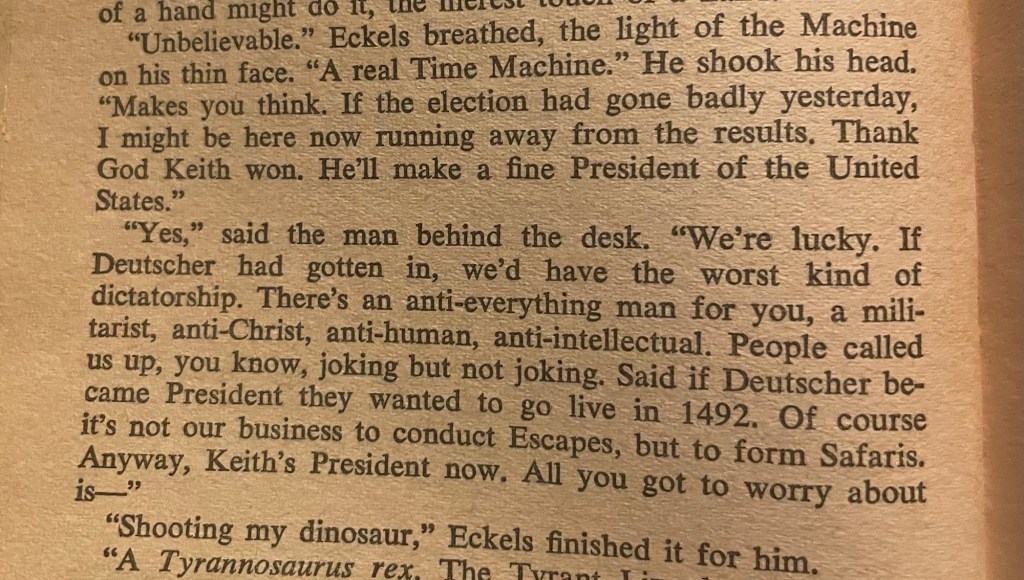
This story stuck with me perhaps more than the others, and only partly because of the unintended consequence at the end involving the election of a strong man named Deutscher as president, “not that fool weakling Keith.”

At the beginning of the story, the “man behind the desk” at the time travel agency had been excited about the election of Keith.

For one thing, I resolved then and there not to run for public office.

But also my 9th-grade mind was sharp enough to realize that small actions can also, sometimes, yield big results.

Given time.

So I also resolved to engage in those small acts of kindness in the hope for better outcomes.

Yesterday, a little better than half our country’s voters elected what they perceive as a “strong man.” (He isn’t, but that’s irrelevant.)

Each vote cast contributed to that outcome, and it was overnight — even though the small events that led to his popularity took decades — against all odds, common sense, moral dignity and good taste — to have their cumulative effect.

What I want to advocate now is serious rebellion against that trend — in tiny, quiet, small ways. Acts of kindness. Words of support. Unashamed expressions of brotherly love. Showing grace. Being generous. Fostering unity.

It may take time — perhaps not millions of years, like Eckels’ journey — but that only means the best time to start is right now.

I might even end up running for public office as a result.

You might one day elect that fool weakling Keith.

(Below: 1. an excerpt from near the close of “A Sound of Thunder.” 2. The story’s earlier description of Deutscher.)

Freedom to choose

What so many of my fellow Christians fail to understand is that freedom of religion and the separation of church from state in a democracy is the ideal environment for faith to grow.

Because our faith is based on choice.

Always has been. Always will be.

From the choice of fruit in Eden to “choose you this day whom you will serve” to the great and mudane daily choices we make to try and reflect the nature of Christ, it has been our freedom to choose that’s the key.

Not coercion. Not enforcement. Not Sharia-type law.

A choice that’s forced is no choice at all. It doesn’t create a change of heart, or compel a desire to live graciously, or inspire a devotion to truth or justice or kindness or respect.

And the attitude that Christians are somehow morally superior to make these choices for others through law or compulsion — simply because we’ve have been forgiven — is ludicrous on its face. No one should have that attitude because none of us has that moral authority.

Were we asleep when we read or were taught that we are not to judge, or do we just choose to ignore it in a consistently defiant way?

And how effective is that kind of arrogance in trying to attract people while we say we are imitating Christ? Surely that hypocrisy is transparent to the most casual observer!

Did we miss the fact that scripture teaches God gave law to a new and undisciplined nation emerging in a savage and primitive environment — but it wasn’t good enough long-term to draw people closer to His nature, so grace had to be brought by His own Son? How difficult is that to understand? Law can only do so much! It was the schoolmaster until the Master arrived.

We believers have inched away from who He is and what He taught until we are nearly as far away, savage and primitive as the early era of law was from its inevitable Successor.

I’m no preacher and not even qualified to play one on TV — but these truths ought to be taught and preached and insisted upon until they are so obvious that it’s an embarrassment to deny or ignore them.

Choice, not coercion.

Faith, not force.

Compassion, not control.

Grace, not governing.

Love. Not law.

Your neighbor. Yourself. Your enemies.

No exceptions. No excuses.

If we want others to live changed lives, we need to live lives that are changed, exemplary, gracious, forgiving, generous, lovely.

You can’t make that a law.

It has to be chosen.

And maybe we need to be looking into the faces and hearts and lives of people around us who don’t believe, but live that kind of life, and we need to see Jesus there instead of in the mirror and we need to ask ourselves why.

The Conversations We Need to Have

Look, I know that I post things here sometimes that make people uncomfortable … in the deep hope that it will prod them to ask themselves why a post makes them uncomfortable.

I make no apology for that.

And I understand that many people would prefer that their social media just be filled with humor; encouragement; wisdom; photos of kids, food, flowers, pets, landscapes and unique things — rather that posts that trouble and require thinking and reflection.

I totally get that. Sometimes I scroll past the troublesome, too. I just don’t have the energy for them. Sometimes you should too.

It may seem that those posts of mine are intended to be divisive. That’s not the case. My hope is that they can spark thought and dialogue about reconsidering the values that can make one country or people or generation great.

We need to have these conversations, and this social media forum is a place it can begin.

Does it make us great for political leaders to support and encourage insurrection to defy the voters’ choices with no consequences, or to punish them with (at the very least) removal from office?

Does it make us great for our legislators to baldfacedly lie about themselves, cheat others, perhaps even steal and not face consequences, or for them to be suspended from office until justice takes place?

Does it make us great to be force-legislated into the culture and ethic of one group of controlling people — especially when it represents a particular religion —or to have open dialogue about what is right for all?

Does it make us great to teach future generations a sanitized history or to tell the whole truth about our past and present?

Does it make us great to limit voting opportunities and representation rights for a certain group of people or to give equal voice and vote to all?

Does it make is great to single out certain groups of people and label them undesireable and limit their freedom of self-expression, or to recognize the universal right to be and express oneself — so long as no violence is done to anyone?

Does it make us great to ban books for everyone that make a few uncomfortable, or to let books compete in the free market of ideas?

Does it make us great to have government decide whether a person must bear a child/children, or to let that person decide with access to specialist doctors?

Does it make us great to support a system of health care that can be good for those who can afford it but beyond reach for many, or to see to it that it is available to all without a lifetime of debt afterwards?

Does it make us great to spend trillions on war and defense (more than all of the next 10 highest-defense-spending nations combined) or to see to it that the hungry do not starve, the homeless are housed and the jobless are trained and gainfully employed?

Does it make us great to ensure that anyone can easily have as many of any kind of guns and ammunition they desire, or to protect the lives of citizens — of children in schools — by banning the kind used in the military to obliterate as many lives as possible in the least time with the least effort?

Does it make us great to let the free market pay the lowest possible wage for the highest possible profit, or establish a living minimum wage appropriate to regional cost-of-living so that earners are not burning themselves out on two or three jobs just to make a living?

We need to have this dialogue and regard it as damn important to the future — ours, our kids’, their kids’.

And we need to start making some wise choices.