Misidentified

It costs you absolutely nothing to respect another person’s identity and use the pronouns for them that they prefer.

Not one red cent.

You accommodate a woman who marries and tells you whether she wants to be addressed as “Ms.” or “Mrs.” or by her husband’s last name or her original last name or just her first name. It may be a little complex, but you do it.

You use the title “Dr.” when a person earns that degree.

You want people to use the correct way of addressing you, don’t you?

I bring it up because, once again today, I was misidentified. I’m an old straight dude with a beard and long hair who has always identified as male. But the Walmart supervisor behind me at the self checkout asked me, “Do you need any help, ma’am?”

And when I turned, smiling, and she saw my beard, she blushed and apologized. “Oh, it’s you!” she said. (We’ve chatted amiably many times.) “I’m so sleep-deprived I don’t even know who I am today!” she added.

“It’s the hair; it throws people off,” I grinned. “Not a problem.”

(By the way, her lovely white hair is worn in a crew cut.)

It didn’t cost her anything to want to address me correctly; not a penny. And her kind, self-effacing apology quickly communicated that she respected that.

We don’t lose anything by respecting others. In fact, we stand to gain something by getting to know people and respecting them, even if we’re unfamiliar with how they see themselves.

We stand to gain a friendship.

We learn by listening, and we stand to gain a deeper understanding of and respect toward others — as, I would venture to say, we would appreciate others respecting and getting to understand us better.

And it literally costs us nothing.

A Sound of Thunder

Butterfly Effect

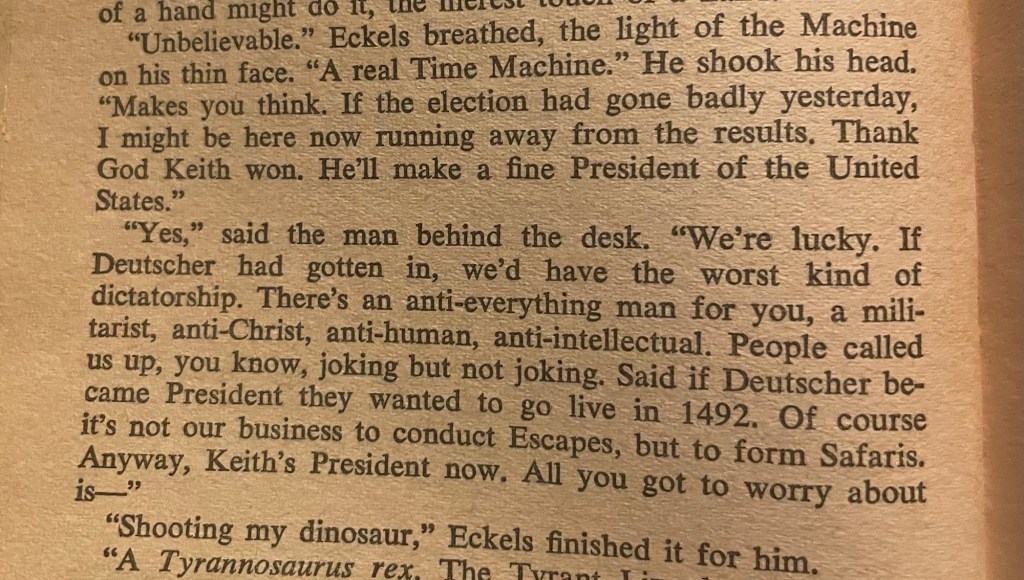
In 1952, science fiction writer Ray Bradbury published a short story titled “A Sound of Thunder,” almost certainly inspiring the thought-problem term “butterfly effect” coined by meteorologist Edward Norton Lorenz in the 1960s.

“Butterfly Effect” describes the phenomenon of a tiny event (the death of a butterfly under time-traveler Eckels’ boot, in Bradbury’s story) inexplicably causing a huge consequence later on.

In 9th grade I managed a paperback book shelf inside Perry East Junior High before school and spent most of my earnings there. I bought “R is for Rocket,” an anthology containing the short story by Bradbury and devoured every word.

This story stuck with me perhaps more than the others, and only partly because of the unintended consequence at the end involving the election of a strong man named Deutscher as president, “not that fool weakling Keith.”

At the beginning of the story, the “man behind the desk” at the time travel agency had been excited about the election of Keith.

For one thing, I resolved then and there not to run for public office.

But also my 9th-grade mind was sharp enough to realize that small actions can also, sometimes, yield big results.

Given time.

So I also resolved to engage in those small acts of kindness in the hope for better outcomes.

Yesterday, a little better than half our country’s voters elected what they perceive as a “strong man.” (He isn’t, but that’s irrelevant.)

Each vote cast contributed to that outcome, and it was overnight — even though the small events that led to his popularity took decades — against all odds, common sense, moral dignity and good taste — to have their cumulative effect.

What I want to advocate now is serious rebellion against that trend — in tiny, quiet, small ways. Acts of kindness. Words of support. Unashamed expressions of brotherly love. Showing grace. Being generous. Fostering unity.

It may take time — perhaps not millions of years, like Eckels’ journey — but that only means the best time to start is right now.

I might even end up running for public office as a result.

You might one day elect that fool weakling Keith.

(Below: 1. an excerpt from near the close of “A Sound of Thunder.” 2. The story’s earlier description of Deutscher.)

A wrong turn

I think Christianity took a wrong turn, and much farther back than you might think I’m going to say. I think it took a wrong turn when it became a religion instead of a way of life.

After three years of abstaining from scripture, I’m going back a little at a time to see if what is imprinted on my memory and mind and soul is accurate, reliable, valuable.

I’m trying to divorce it from what I’ve been taught it says and told it means and drilled about its characteristics. I’m trying to just read it.

I’m starting with the gospels. And there I find nothing about Jesus expressing a desire to begin a new religion, but rather to fulfill an old one. I find no pleas from Him to build structures and governances and hierarchies and rules about what to do and how. I find no support for worship or rituals or traditions that lose meaning through repetition because they may be periodically spoken or sung but not LIVED.

Instead I find prophecy about how the old ends and the new begins. I find stories about accepting and rejecting grace; about accepting and rejecting others; about accepting and rejecting Him. I find teaching about how to live, how to be fulfilled, how to show grace and love and compassion for others. All interspersed with His example of living and doing these things as well as teaching them.

I find medicine for broken relationships.

I find promises of His presence.

I find guarantees of His grace.

In fact, the words of judgment that I find are for the religious, the ones who judge, the ones who reject, the ones who make it hard for others to access grace. The ones who are in bed with government they do not trust and will conspire to take His life because it is politically expedient — and will justify their judgment and conspiracy and lies and murder.

What I remember of the story after that is that it goes all right for a while. The story of His life and teachings is told far and wide, and people gather to hear it and keep gathering to reinforce their belief in a life that’s good and noble and gracious — even to the point of ultimate self-sacrifice. A perfect example of it.

The people who originally told the story chose the wise and most caring to shepherd the rest and moved on to tell the story in other places.

But, people remain people. Just like we do. Even if changed in heart and soul, it’s never complete. Gatherings became churches; synagogues with rules about who’s in and who’s out, who’s in charge, what does this mean or can’t mean, what worship includes and doesn’t, and so on and on.

And the letters we read from the people who originally told the story to the people-having-problems-with-being-people keep pointing them back to the “how-to-live” teachings of Jesus, though they sometimes stray into making new rules.

I think it’s natural and human that another religion resulted from the teachings and example about how to live. I’m pretty sure Jesus saw it coming. I understand that a lot of people benefit from the fellowship of shared belief with others; are uplifted and encouraged with worship together; are strengthened by messages that urge them on and reinforce their faith. Some folks need the ritual and the repetition. Church has its place in faith.

Probably in most religions, not just Christianity.

But if the focus is on self — even on the community of faith that one’s self is surrounded with — rather than living that story, that grace, that Jesus … then it truly is just another religion. Perhaps His name is there, but … His presence?

It’s the way of life that gives meaning to the religion.

Christianity can’t just be another religion, and still be Christianity.

It has to be a way of life.

His life.

Freedom to choose

What so many of my fellow Christians fail to understand is that freedom of religion and the separation of church from state in a democracy is the ideal environment for faith to grow.

Because our faith is based on choice.

Always has been. Always will be.

From the choice of fruit in Eden to “choose you this day whom you will serve” to the great and mudane daily choices we make to try and reflect the nature of Christ, it has been our freedom to choose that’s the key.

Not coercion. Not enforcement. Not Sharia-type law.

A choice that’s forced is no choice at all. It doesn’t create a change of heart, or compel a desire to live graciously, or inspire a devotion to truth or justice or kindness or respect.

And the attitude that Christians are somehow morally superior to make these choices for others through law or compulsion — simply because we’ve have been forgiven — is ludicrous on its face. No one should have that attitude because none of us has that moral authority.

Were we asleep when we read or were taught that we are not to judge, or do we just choose to ignore it in a consistently defiant way?

And how effective is that kind of arrogance in trying to attract people while we say we are imitating Christ? Surely that hypocrisy is transparent to the most casual observer!

Did we miss the fact that scripture teaches God gave law to a new and undisciplined nation emerging in a savage and primitive environment — but it wasn’t good enough long-term to draw people closer to His nature, so grace had to be brought by His own Son? How difficult is that to understand? Law can only do so much! It was the schoolmaster until the Master arrived.

We believers have inched away from who He is and what He taught until we are nearly as far away, savage and primitive as the early era of law was from its inevitable Successor.

I’m no preacher and not even qualified to play one on TV — but these truths ought to be taught and preached and insisted upon until they are so obvious that it’s an embarrassment to deny or ignore them.

Choice, not coercion.

Faith, not force.

Compassion, not control.

Grace, not governing.

Love. Not law.

Your neighbor. Yourself. Your enemies.

No exceptions. No excuses.

If we want others to live changed lives, we need to live lives that are changed, exemplary, gracious, forgiving, generous, lovely.

You can’t make that a law.

It has to be chosen.

And maybe we need to be looking into the faces and hearts and lives of people around us who don’t believe, but live that kind of life, and we need to see Jesus there instead of in the mirror and we need to ask ourselves why.

Knowledge and Belief

I’m never going to discourage study, but you can still believe what’s written in scripture about love, holiness and the nature of God without deeply understanding everything written or implied there.

Once again, here’s my example from John 21: Peter and the ”other disciple” (apparently how John humbly refers to himself) enter the empty tomb and believe Jesus is risen EVEN THOUGH they don’t understand the idea of resurrection described in prophecy and predicted by Jesus.

They didn’t get it.

They believed anyway.

And I keep saying this because of the danger of getting so deeply invested in human interpretations and conclusions drawn from what’s written that we start judging others’ faith and arrogantly call them heretics and exclude them and further divide the body unified by His Spirit.

And I know too well the defense mechanism that says, “Well, there are certain basic principles that we have to all agree on ….”

No.

That way lies judgment, wallbuilding and madness.

Peter didn’t agree with Jesus’ plan to go to Jerusalem and allow Himself to be killed and to rise again. That’s a pretty basic disagreement. But it’s on the foundation of faith like Peter’s that Jesus builds.

Disagree, but don’t divide.

Dialogue.

And don’t forget that, in speaking of Jews and Gentiles, of strong and weak faith, the author of Romans recommends:

“Accept one another, then, just as Christ accepted you, in order to bring praise to God.” (15:7)

Do you think the people being written to believed everything exactly alike, according to some magically unwritten standard of orthodoxy? What are the odds of that happening? Then? Now? Ever?

You know what we believers can believe and agree on?

What is clearly written in scripture. What Jesus taught. How He lived. Whom He loved. (Hint: Everyone.) That He died. That He lives again.

And if that isn’t enough to give weight to the cosmic importance of loving others as the basis of everything we do — as opposed to judging and hating and condemning — then what would it take to convince us beyond God has already done?

We’re not on this world to sate our greed, to judge and hate others, to divide and destroy.

You don’t even have to study or believe scripture to understand that.

Lack of faith

I still have the same faith in God that I’ve always had. I’ve lost faith in church.

Which is to say, I’ve lost faith in people.

And I’m not sure that ritual — however much we may think we need it — is the best way that worship is communicated; that single-use once-a-week buildings and structures are effective or cost-justifiable in getting God’s work done with Him in this world; or that human authorities, hierarchies, teachings and traditions that judge and exclude others glorify Him or draw others to Him at all.

I retired from a short stint in preaching ministry three years ago, but this conclusion is a long time a-comin’. Decades. More than half of my 67-year life.

I can’t apologize for this.

It’s a doubt that is deeply and honestly held.

Sermons

They seem to be the centerpiece of the worship service at church, no matter how long they are or what they’re called: sermons, teachings, messages, homilies.

I’m not sure they should be, but they kind of are by default for almost a couple thousand years now.

I would vote for the eucharist, the Lord’s supper, to take that honor and let Him host and be the center of worship, honor and praise.

But, hey, nobody asked me.

So we surround the sermon with all our other acts of worship (singing, prayers, reading of scripture, etc.), and — like I said — it becomes the centerpiece of the table we surround by default.

And what do we hear?

I attended church from before the time I could think or speak until just a couple of years ago. I think I can fairly say I’ve heard about every kind of sermon imaginable, from the very best to the very worst.

I learned a lot, I’m sure; and some of what I learned, I had to later unlearn — because what I heard was not valid, or helpful, or sometimes just wasn’t true. Occasionally it didn’t even conform to what scripture said, and even rarely contradicted and defied it.

But looking back, I think the very best sermons I heard gave me insight into the life, teachings, example and nature of Jesus of Nazareth.

They conveyed His humanity and divinity, His winsome appeal, His unflagging love for all, and His refusal to judge people while being unflinchingly judgmental about how to speak, act and relate to others in a world that God made and God cares about and God watches over all the time.

Sermons like that made me crave that nature and yearn for that living grace; they challenged me to imitate it in what I do and say with the goal of making it my nature.

I genuinely don’t know how you can preach a gospel sermon without talking about Jesus; He is the very best of all the good news in scripture. I tried preaching for several years, but it is not my gift. When I did preach, I genuinely tried to draw my listeners to the grace of Christ.

To the cross, yes, sometimes; even to the empty tomb. But, you see, that’s what the Lord’s table is for; that’s largely His story to tell in His inimitable way — by living it to death and then living it forever.

I can’t do better than that.

And you see, if that were all there is to His story, we would miss out on the part that makes it whole and full and complete: the incredible life of love and compassion that He lived. That, as much as anything else, is what proves He was/is/will always be the Son of God.

God could have raised anyone from the dead — it’s not like He’d never done it before! But who else but His very own Son could have lived such an exemplary life, seen and communicated the loving grace of heaven so clearly, had the unalterable faith to let mankind do its worst and still speak words of forgiveness?

Sermons come and go. A million every Sunday, maybe, all around the world.

But they are only heard by the people who listen to them; and if those people don’t leave that church inspired to live what they’ve heard, then only words have been spoken. Not The Word, the living Logos, the meaning of what God spoke into existence, the why of being, the purpose of living, the joy of loving, the embodiment of grace.

Well, I’ve rattled on here long enough. If I could live like that, I could still try preaching. But I know there is no credibility in what you say if you don’t practice what you preach.

So I’ve chosen to leave that to others of better qualifications, and just do my best to live up to some poor semblance of the One that I most admire.

They say that’s a sermon too.

I Don’t Know Anything About God

And neither do you.

What we say we “know” are items accepted on faith, communicated through scripture, written by mortal men. We accept them as inspired; we accept them as factual — but we accept them on faith.

I think it’s important to recognize that. Constantly.

Because overconfidence in what we “know” leads to an overweening pride in our own ability to interpret what we have read and accepted. Leads to arrogance. Leads to sects and parties and division and downfall.

Leads to loss of faith. Loss of faith, in favor of “knowledge.”

And I have to confess that in the past few years, my faith has changed. I hope it has matured, but I know it has changed.

I believe God exists, that He loves, that He cares, that He saves.

That means that I believe God cares in a divine way that I don’t necessarily comprehend. Perhaps even cannot understand.

For instance ….

Because I have faith in God, I have faith that God will let bad things happen to good people. He is God, and He can do what He likes in His own way and wisdom and time. I don’t know why. I don’t have to know why. If I needed to know why, I have faith that He’d have told me.

I have my own ideas on the matter, but they’re mine and they could be wrong — and ultimately they’re not important.

If they were important, I’d have answers.

I hope that doesn’t sound cynical, but I’m sure it does — especially to people who are certain that they “know” a lot about God. I think it’s just a recognition of reality.

But I also believe that God came, was and is present as human — in the form of the One whom we call His Son, Jesus — and therefore cares in a human way as well as a divine way.

Yet still lets bad things happen to good people. Lets good things happen to bad people (like grace). Lets things of all kinds happen to all kinds of people. And all the praying in the world will not sway His will if we are praying for something that is — in the divine perspective — not ultimately good for us; not something that can be within His will.

This is the God who let His Son suffer and die to give us the perspective of grace, a glimpse at eternity, a taste of blood and bread and the way that His world should be.

So we pray from a human perspective and receive our answers from the divine perspective. And the divine perspective calls on us to try to see them from His point of view. Even if we can’t do it. We must try.

Because we are also called to be part of the human answer to human prayers. Forgiving. Generous. Gracious. Kind. Loving. Self-sacrificial.

Part of the effort to make good things happen to all people. I believe that creating us, giving us His Son, showing us His grace, was all the work He needed to do; that it is sufficient. I can pray all I want to. But in the final analysis, I might as well just recognize that my prayers have (and must have) the power to change me. That’s entirely up to me.

Whether they have the power to change what He has planned to do in order to bring about good is entirely up to Him.

That’s what I believe about God. Just what I believe. Not what I know.

Because I don’t know anything about God.

And neither do you.

Sometimes I’m Sad

… that I can’t be the kind of Christian everyone expects. You know?

The kind with a contemporary Christian hymn in their hearts all the time. The kind who is always eager to tell someone about Jesus at the first excuse. The kind who goes to church faithfully, every time the door is open. The kind who gives generously every week he attends. The kind that can vote a certain way with no qualms in their conscience. The kind who believe God is in control of every minute detail all the time because He chooses to be. The kind whose kids turn out the way everyone expected them to. The kind who doesn’t question the traditions. The kind who gets along.

But that’s just not me. Some of those things were never me; I just didn’t make a big deal about them.

The fact is, I can’t be that kind of Christian. And I won’t pretend.

I’d rather be genuinely me than someone who says and does what must be done to fit in.

The contemporary Christian hymns — frankly, all the songs sung at church — are not the comfort they once were. They remind me of my departed Angi, who loved them and had them in her heart all the time and listened to them in the car and on her iPhone in the office. And that just raises difficult questions for me about God’s goodness that nobody actually has answers for, so it makes the faith and the trust in Him that I still have even more difficult.

My eagerness to share a gospel message is not what it was. For one thing, people find it off-putting and self-righteous and often not credible from people who can’t live up to it, and I am one of those far-from-perfect people. I’ll be glad to tell anyone who asks about the reason for the hope that lies within me (to put it in scriptural language), but most of the time it’s all I can do to try to be like Jesus of Nazareth. I used to preach. Now it’s just a matter of practice. In this case, practice won’t make perfect. He has to do that. I get that. I grasp the concept of grace, even if I can’t fathom the depths of it.

And I haven’t been to church but a couple of times in the past two years and more. I have questions and concerns about what church is and should be and how it’s done and what its purpose and expectations are that far exceed the word count of a readable post.

Giving to support some of those things I’m not sure I can believe in … well, that’s just not an option right now. I can give to support people I know who are in genuine need; I can give in other ways in total anonymity; I can give to the kinds of things that Jesus of Nazareth talks about giving to support. Did you ever notice He never once talked about giving to His church in scripture?

Frankly, I am horrified at the political tack that churches have taken to support a particular party and even economic/social ideology that I often find antithetical to the life that He lived and the way He loved and the extent to which He gave … even to His own life. For people who never earned it, never worked for it, never could, never will.

Because I can’t believe God shows favoritism, to rich or poor, one skin color over another, one ethnicity over another, one set of life choices over another, one religion over another, one soul over another. If He loves the whole world, then the Son He gave is for everyone. But God as micro-manager? Undoing everything in some karmic cosmic way that intentionally harms some people to the benefit of others; that’s one thing. But to undo the real-world consequences of it as if that doesn’t matter in this world at all? No. I can’t vote that way or believe that way because He doesn’t operate that way. Whether you take the story of Eden literally or not, the gist of it is that He gave us choice in the very beginning and He doesn’t interfere with the consequences and rewards of what we have chosen. Others might, but not Him. Evil still exists in this world because we still choose it; we choose self instead of others and Him. And that’s why there’s still death in the world, why there’s still suffering in the world, why there’s still inequity and hatred and greed and poverty and illness and crime and murder and bigotry and ….

Well, you get the idea. I don’t have all the answers. But that much seems obvious.

I choose. You choose. Our kids choose. Their kids choose. And we’re responsible for our own choices; no one else’s. I’m glad and proud that my kids are into adulthood, still forming their own spirituality just like their dad is. I’m proud that Angi and I helped instill and nurture a yearning for a deep spirituality in them. I can hope it leads them into good lives that care deeply about others. So far, it’s looking that way to me. What they do for a living, as far as I’m concerned, is relatively inconsequential compared to how they live their lives.

If they turn out anything like me, they’ll never accept tradition for the sake of tradition; never choose to go along just to get along; never be solely what someone else expects of them.

But sometimes I’m sad I can’t.

Rarely. But sometimes.

Because that would be easy.

I am apostate

Bless me, Father, for I have sinned.

Or at least abstained from gathering with the saints.

It has been six months, two weeks and two days since I have been to church.

I have forsaken the assembly.

Well, not totally. I still pray for my church family. I still pray for people who are not in my church family, but who feel like family. Surely they need Your help as much.

You see, that’s where I’m having this problem. I haven’t lost faith in You, Father; nor your Son; nor your Holy Spirit. I’ve lost faith in your church. The Bride of Christ. At least, I’ve lost faith in the way we’ve conducted ourselves.

As if we’re just married one or two hours of one day every week.

But that’s not all, either. I also feel like when we gathered to worship, it’s all about us. The songs we like to sing. The scriptures we like to read. The prayers we like to repeat. The sermons we like to hear. The gifts we like to put in the collection plate. The potlucks and activities we like to participate in. All in the building we like to have around us with the pews we like to sit in.

I’m just not at all sure that’s what You meant by “church” or “assembly.” I’m not convinced You intended for it to happen once or twice a week, every week, with the same rituals played out over and over with the same words spoken and sung and prayed. I’m not positive that the gifts we give should be largely funding a building and its expenses or even a ministry staff. I’m not certain any of that equates to worship.

Because it feels like, if that’s what worship is, we can only do it then and there and when we’re all together, and I don’t find that to be the case in scripture.

And I have to wonder if the time of worship in a specific place at a specific time with everyone gathered was supposed to end when the temple in Jerusalem was destroyed just as Jesus of Nazareth, your Son, predicted. That worship was to be constant, and prayer was to be constant, and singing was to be constant in our hearts — whether we’re alone or together in our homes or a borrowed place or on a seashore or a mountainside or a plain or wherever.

I get the picture that our gifts should be blessing the hungry and sick and poor and homeless. That there wouldn’t be as many of them and the destitution wouldn’t be so extreme if we weren’t spending our gifts otherwise. Mostly on ourselves.

I’m just not comfortable with the way we’ve been conducting ourselves as your family and the Bride of your Son.

I don’t preach anymore because it feels that my life should be the sermon seen and heard by those who aren’t familiar with You, or have had an awful experience with people like me who preached You but didn’t live You or love like You or bless others like You do.

I can’t see myself doing it the old way anymore. I’m spending more time, I think, with people who don’t really know You; people who feel like family whom You would love to hear calling you “Father,” and trying to drop hints to them that they’re loved and You’re listening and that You care.

I feel more at home among my fellow sinners, Father; You know I do.

And I don’t even know whether to be sorry about that.

I know that your family still gathering will be fine without me there. They don’t need to see my doubt and hear my lack of faith in church as they love it. I still love them, and I miss them, and I just can’t be there for them the way I used to be any longer. It’s not their fault or your fault or anyone’s fault, as near as I can tell — not even mine.

I’m just different in my doubt now.

I still believe in them, too; and that they will do much good and their hearts will worship You and people will be blessed.

That’s what I needed to confess. I will never forget what your Son said or did or gave for us, nor cease to be grateful for it, nor will I ever give up on church altogether.

I’m just with a different church now. The one that doesn’t really know You yet. The one willing to shake any preconception of the way church is or must be in order for You to be pleased and worshiped.

I want to hang with them, and be less of myself and more like You. Loving. Accepting. Gracious. Forgiving. The nonconformist who fishes for men and shepherds people and shares meals and tries to help heal brokenness.

That’s my confession, Father. I may be totally wrong and off-base, and if so, I’m doubly triply sorry. But I can’t believe in church as church is done right now, and I have to try something else.

Lord, help my unbelief.