You will hear of wars and rumors of wars, but see to it that you are not alarmed. Such things must happen, but the end is still to come. ~ Matthew 24:6
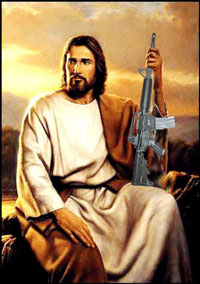 I am always a little amazed when someone brings up a verse or two — like the one above — to justify a Christian’s involvement in war.
That verse and its parallel in Mark 13:7 are in the middle of Jesus’ prediction of circumstances that will characterize but not necessarily herald the end of time and His return. They are prophecy; not a command to take arms — no more than this verse:
Do not suppose that I have come to bring peace to the earth. I did not come to bring peace, but a sword. ~ Matthew 10:34
This is a snippet from a larger conversation about how even families will be split apart by the truth about who Jesus is; and the importance of standing by the truth rather than acquiescing to family loyalties and denying the truth. Here, the truth is the sword which rends families asunder (Luke 21:15-19). (It is a metaphor Paul and the writer to the Hebrews — inspired by the Spirit of Christ — pursue in Ephesians 6:17 and Hebrews 4:12).
Then Jesus asked them, “When I sent you without purse, bag or sandals, did you lack anything?”
“Nothing,” they answered.
He said to them, “But now if you have a purse, take it, and also a bag; and if you don’t have a sword, sell your cloak and buy one. It is written: ‘And he was numbered with the transgressors’; and I tell you that this must be fulfilled in me. Yes, what is written about me is reaching its fulfillment.” ~ Luke 22:35-38
The disciples said, “See, Lord, here are two swords.”
“That’s enough!” he replied.
It is an assumption that Jesus advises the purchase of a sword here in order to fight a physical battle or for self-protection. Two swords would hardly have defended twelve men, and He pronounced them sufficient. However, one sword was sufficient to sever the ear of a servant at His arrest, and give Him the opportunity to perform one last miracle that should have testified to all present and arresting or defending Him of who He is, and by what power He spoke the truth (47-53). In those verses, His command is “No more of this!” — and He contrasts those who wield weapons to arrest Him as if He were leading a rebel posse rather than teaching disciples as He had in the temple courts.
Two swords among twelve would also have been sufficient — assuming that they would flee together — to provide food for them in the wild, where He had just advised them to go (in the previous chapter, Luke 21:21) in order to escape the tumult that was to come.
And writing of the tumult that was to come, John of Patmos describes the unnamed Jesus three times as a princely hero bearing a sword (Revelation 1:16; 2:12-16; 19:15-21). All three times that sword is pictured as proceeding from His mouth. This, again, is the sword of truth — against which those who lie (and believe lies rather than the truth) have no defense whatsoever. This is, again, a highly prophetic passage with language appropriate to prophecy. The war described is indeed a cosmic one in eternity, and the battlefield is not on any literal plain on earth, but in the human heart. (2 Corinthians 10:3; 1 Peter 2:11).
If we who believe cannot win in our own hearts that battle of love for survival of self at the cost of God and the lives of others — if we cling so tenaciously to this life and all of its possessions, attractions, political affiliations, nationalistic loyalties, ideological idolatries — how can we hope to enlist in His army to assist others with the battle in their hearts?
But I tell you, love your enemies and pray for those who persecute you, that you may be children of your Father in heaven. He causes his sun to rise on the evil and the good, and sends rain on the righteous and the unrighteous. If you love those who love you, what reward will you get? Are not even the tax collectors doing that? And if you greet only your own people, what are you doing more than others? Do not even pagans do that? Be perfect, therefore, as your heavenly Father is perfect. ~ Matthew 5:44-48
Let me ask something: When Jesus says “Love your enemies and pray for those who persecute you,” does He mean before or after running them through with your bayonet?
“You have heard that it was said, ‘Eye for eye, and tooth for tooth.’ But I tell you, do not resist an evil person. If anyone slaps you on the right cheek, turn to them the other cheek also.” ~ Matthew 5:38-39
When the Savior says “Turn the other cheek,” does He mean make sure of their intentions before you beat the very life out of them?
“You have heard that it was said to the people long ago, ‘You shall not murder, and anyone who murders will be subject to judgment.’ But I tell you that anyone who is angry with a brother or sister will be subject to judgment. Again, anyone who says to a brother or sister, ‘Raca,’ is answerable to the court. And anyone who says, ‘You fool!’ will be in danger of the fire of hell.” ~ Matthew 5:21-22
When He says “Anyone who is angry with a brother or sister will be subject to judgment,” does He mean that it’s okay to murder if you do it dispassionately, without any anger at all toward your victim?
Blessed are those who are persecuted because of righteousness,
for theirs is the kingdom of heaven. ~ Matthew 5:12
Does He imply that it’s okay to persecute others for their unrighteousness because the kingdom of heaven is yours?
Blessed are the peacemakers,
for they will be called children of God. ~ Matthew 5:11
Does He mean that warmongers will also be called children of God?
Blessed are the merciful,
for they will be shown mercy. ~ Matthew 5:7
Does He imply that the invasion of other nations, confiscation of their properties, wholesale slaughter of their uninvolved citizenry as well as their armed forces — all of that is an exceedingly great mercy when used to rescue them from a disagreeable and unprofitable government or religion or philosophy?
I’m not writing this to argue for or against a “just war” doctrine, or whether a Christian can object to or participate in a war. Those are, by definition, issues of individual conscience and you will have to make up your mind about them on your own.
I’m just asking whether the whole concept of physical war in this world with weapons and intentions that mutilate and murder and destroy are consistent with the picture of Jesus’ life and teachings as they are revealed in scripture.
When we use scripture out of context and for our own purposes of proof, aren’t we contorting it beyond the use and meaning it was originally meant to have?
If that’s true, and we can all agree on that, doesn’t it follow that Jesus came to this world to bring the sword of truth that would render asunder the hearts and souls of men, cleave precious relationships — and also surgically create new and eternal ones — based on a gospel about a God of love willing to sacrifice what was most precious to Him in order to reconcile Himself to those by whom He wanted to be regarded as most precious and beloved?





 Blog In My Own Eye