The Argument

There’s quite an argument going on in the comments of one of my previous posts.

I can’t tell you that I have been carefully monitoring it, eager to jump in with just the right “AHA!” that will prove how gloriously intelligent and inspired and above-all-else RIGHT I am.

If you believe that my salvation or yours hangs on being a perfect and omniscient blog moderator on all matters biblical and spiritual, then I am sorry to disappoint you, but certain I am not the first (nor will I be the last) to do so.

Hey, the argument isn’t even about what I posted.

But it does an en exceptionally good job of illustrating the point I had hoped to make.

Both of my beloved arguing brothers is utterly convinced that his interpretation of a number of scriptures supporting his point of view is so inarguably RIGHT and so self-evidently clear and so vitally crucial to the salvation of everyone on this planet that no one who disagrees with it can share in the fellowship of Christ.

The two points of view are different, so they cannot possibly agree and therefore one of them must be wrong and the other must be RIGHT.

The problem with that is that they can be different and still agree; and both could be right (at least to a degree) and both could be totally wrong (by being wrong in part).

And of course, since the nature of God is at issue, the probability of error is extremely high when one point of view is deemed to be wrong because with God nothing is impossible.

If we stuck to scripture without interpreting it, we would all agree that it says Jesus is the Christ and Son of God, who rewards those who diligently seek him, and the things that scripture says about Him are sufficient to lead anyone into a closer relationship with Him and into a life that reflects His glory and story.

But we all interpret. What happens when we start to believe that our interpretations are just as important as scripture – or perhaps even ARE scripture – is the fallacy of self above God, opinion above truth, creed above scripture, arrogance above humility, self-righteousness above grauce, RIGHTness above righteousness, winning above loving.

That is when we fall into the seductive snare of the argument.

And you rarely if ever see anyone emerge victorious by winning a soul over to God’s side … though perhaps you might sometimes see someone who has cowed his adversary over to his own side.

Because we hardly ever argue about what God actually says, but over what we think we know that He meant.

Can good come of an argument?

Sure. When it’s pursued in love, humility and a recognition of the difference between truth and perception; God’s word and man’s doctrine. I think God knows we’re all different and perceive things differently — He did create us this way, after all — and He expects us to disagree and even argue.

I think He expects us to argue like believers, though — and not like those to whom His love is a foreign concept.

Healthy, respectful argument helps bring the Word alive in our minds and hearts, challenging us to dig deep, read, listen and respond in love.

Jesus, John says, came to us full of grace AND truth. Not one or the other, but both, and in perfect balance. He argued — and sometimes strongly, harshly — but He was and is the Son of God. We are not, save through His blood and His righteousness.

And the folks with whom He argued most reprovingly were the ones who were absolutely convinced of their own infallible RIGHTness.
The Wicked Wretch is Dead

I am glad Osama bin Laden is dead and I am not sorry to say so.

I am sorry he did not repent, but his actions would lead one to believe that he was among those people whose consciences are seared; who call good “evil” and evil “good.” I fear that it is almost impossible for someone to repent who cannot distinguish good from evil. And he recruited thousands to swear their allegiance to his inability to discern good from evil and murder thousands more at his command, believing that to be right and good.

That, as I’ve blogged before, is what (I believe) comprises the sin which cannot be forgiven – the sin of calling good “evil” and evil “good.” (See The Sin That Cannot Be Forgiven.)

I completely trust God to judge Osama bin Laden justly and mercifully, and I completely trust Him to do the same for me.

But Osama is not around anymore to do his part in leading others toward the sin of intentional mis-discernment and on to mayhem and mass murder and suicide – which any right-thinking individual in any culture should recognize as selfish, immoral, unlawful, wrong, evil, and wicked.

And I cannot be sorry about that. I can be reminded to be careful what I call “good” and “evil” by the way I live. Mistaking them for each other begins so easily when self comes first.

So ring the bell if you must.

Ding. Dong.

But ring it quietly for Osama.

Remember that the judgment bell tolls for thee and me – and not just he.

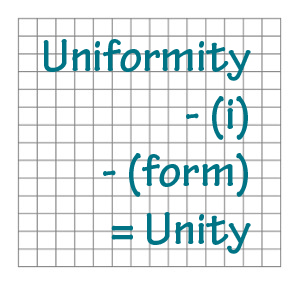
Uniformity – (i) – (form) = Unity

Uniformity - (i) - (form) = UnityI am an unabashedly simple-minded person, and I will will keep this simple so that I will be able to understand it later.

Christians for centuries have mistakenly believed that the way to achieve the unity Jesus prayed for (John 17) is through uniformity.

Wrong. Pretty sure about that. Here’s why I think so:

First of all, unity isn’t ours to achieve, but to maintain (Ephesians 4:3).

Secondly, there has always been room for diversity in the body of Christ, including political opinion. A quick review of the apostles’ views will confirm that; they ranged from tax collector/collaborator to zealot. We are all different members of the body, with differing gifts (1 Corinthians 12-14).

Finally, while there are core beliefs to which every Christian pledges his/her soul, there are other beliefs that are interpretation, which is a churchy way to say “opinion.” There are things that man says and things that Christ says. They don’t always overlap. We’re not always going to agree on opinions; and a short review of Romans 14 will verify that, as well as advise us on how to deal with it.

The real barrier to unity has been our opinions, hasn’t it?

Things like:

  • I know what form of worship should be used.
  • I know what form of atonement was in operation at the cross and the tomb.
  • I know what form the Holy Spirit takes regarding beleivers.
  • I know what form of millennium will shape the future.
  • I know what form of day God meant when describing the span of His creation.

And so on and on and on. No others need apply.

Wow. It really sounds as arrogant as it truly is when I phrase it that way. Yet we’re convinced that we have to – and do – know all the answers in order to have a relationship with God.

Bull-puckey.

This whole walk with Christ is a matter of faith, not knowledge (2 Corinthians 5:7). We have enough knowledge to know who God is, that He loves us, that His Son died for us and lived again so that we could too and that He wants us to live as He lived: humbly, lovingly, self-sacrificingly.

If there’s anything that Job learned from his encounter with the-God-who-showed-up, it’s that you don’t have to know all the answers in order to have a relationship with God (Job 40-42).

So, I’m thinking we don’t have to leave all of our opinions at the church door.

There’s room enough inside for folks who want to believe that God wants to save everyone and will; and for those who want to believe that God wants to save everyone yet won’t.

There’s room enough inside for believers who want to believe we should rejoice that justice was done at the death of Osama Bin Laden and for those who want to mourn yet another soul who did not accept Jesus Christ as Lord.

There’s room enough inside for people who think they know all about God and for those who are just beginning to realize they don’t know much about God at all, but sure want to.

What there isn’t room for is putting up an opinion-poll table next to a crossing gate at the church door and only admitting the folks whose opinions line up with our own.

You see, that violates the very Spirit of the prayer Jesus prayed in the presence of those very diverse disciples on the night He was betrayed by one of them:

“My prayer is not for them alone. I pray also for those who will believe in me through their message, that all of them may be one, Father, just as you are in me and I am in you. May they also be in us so that the world may believe that you have sent me. I have given them the glory that you gave me, that they may be one as we are one— I in them and you in me—so that they may be brought to complete unity. Then the world will know that you sent me and have loved them even as you have loved me.”

For too many centuries, we believers have clung to the opinion that we’ve all got to be and believe exactly the same thing, down to the last opinion … we’ve been wrong. We’ve divided over opinions. We’ve decided that our right opinions were worth our effectiveness as ambassadors of the one kingdom of the one God through His one Christ.

Being brought to complete unity lies in accepting the simple glory of the simple Christ, a radiance that the simple of heart can see in those who love each other and give themselves up for each other the same way that their Lord did.

(This post is part of the synchroblog inspired by Rachel Held Evans’ “Rally to Restore Unity.” Be sure to look her up and all of the other synchrobloggers who are hoping to remove a few bricks from a few walls dividing believers. And while you’re at it, send a few bucks to Charity: Water, the beneficiary of this little online experiment. Right now, my region – Central Arkansas – is aflood and our own water safety could be at risk within hours. Find out what Charity: Water does to improve water quality in developing nations.)

Leaven

This evening at sundown begins Passover, the fifteenth of the month of Nisan. By that time, all leaven / yeast is to be removed from the house of the Jewish families which will celebrate the week of the feast.

For believers in Christ, it’s as good a time as any to remember the warning of Jesus about certain kinds of leaven, the leaven of the Pharisees, Sadducees and of Herod.

It is the leaven of the Pharisees and Sadducees that is proscribed in Matthew 16, right after He fed four thousand and both parties conspired to test Him by asking Him to show them a sign from heaven. (Were they not paying attention? He had just fed thousands of people!)

Mark 8 recalls the same incident, but remembers only the Pharisees present and the warning Jesus gave as about the leaven of the Pharisees and of Herod, and it’s likely that Mark recounts what Peter told him.

In both accounts, the disciples to whom Jesus spoke were confused, thinking that He was scolding them because they forgot to bring bread across the lake on the boat after that sumptuous dinner the night before. Jesus reminds them that He had fed 5,000 and 4,000 men (plus women and children) – and they seem to understand that the nourishment came in settings of teaching – deducing that “yeast” in His metaphor meant the teaching of the Pharisees and Sadducees (Matthew 16:12).

So, what was the teaching of the Pharisees, Sadducees, and Herod?

For simplicity’s sake, I tend to think of it in three words:

Hypocrisy

This would be the Pharisees’ particular brand of leaven. Luke 12 reports Jesus revealing that after pronouncing woe after woe on them in the previous chapter. They had made the law so detailed by their doctrines that it was no longer possible to follow. They bound these heavy burdens of legalism on others, unwilling to lift a finger to help them – but were unwilling to bear their own burden; to practice what they preached.

Hyper-rationality

The Sadducees’ leaven was their own vaulted intellect; they had reasoned out the impossibility of miracles and angels and spiritual beings and life beyond death. Like deists of a couple centuries past, they had de-spiritualized the word of God – completely failing to understand what Jesus told a woman at a well in Samaria: that God is Spirit, and must be worshiped in spirit and truth.

Hubris

I’d have to say that Herod’s leaven was taught not so much verbally as by example. He was the king and he could do whatever he wanted, and that was the law because God had seen fit for him to be anointed. Never mind how he had actually come to the throne or how he kept it; he could do as he pleased. He’d just execute anyone who was inconveniently standing against his royal privilege. Whatever he said and believed was what God wanted him to say and believe.

There’s good leaven: the kingdom of heaven (Matthew 13:33; Luke 13:21). And there’s bad leaven (1 Corinthians 5:6; Galatians 5:9).

As we prepare for the week recognizing the sacrifice of the Lamb of God, it’d be a great time to snoop around and root out these kinds that start with “H.”

There should be no place for them in our houses.

What Is Submission?

Submit to one another out of reverence for Christ.

Wives, submit yourselves to your own husbands as you do to the Lord. For the husband is the head of the wife as Christ is the head of the church, his body, of which he is the Savior. Now as the church submits to Christ, so also wives should submit to their husbands in everything.

Husbands, love your wives, just as Christ loved the church and gave himself up for her ….

~ Ephesians 5:21-25

All sorts of folks quote these verses. Some quote them to prove that women must obey their husbands in everything (but “obey” and “submit” are not quite synonyms).

I don’t know very many people who go on to define what “submission” means by continuing through the next few verses, but that’s what Paul does:

… to make her holy, cleansing her by the washing with water through the word, and to present her to himself as a radiant church, without stain or wrinkle or any other blemish, but holy and blameless. In this same way, husbands ought to love their wives as their own bodies. He who loves his wife loves himself. After all, no one ever hated their own body, but they feed and care for their body, just as Christ does the church— for we are members of his body. “For this reason a man will leave his father and mother and be united to his wife, and the two will become one flesh.” This is a profound mystery—but I am talking about Christ and the church. However, each one of you also must love his wife as he loves himself, and the wife must respect her husband.

~ Ephesians 5:26-33

Jesus Christ submitted to the needs of His bride, the church, by humbling himself and taking the form of a servant and bathing – not only her feet – but her whole body … because he loves and cherishes it, feeds and cares for it … to the point that He left His Father in heaven and submitted to death on a cross to win her and wash her and feed her and be united with her.

That, good people, is what “submission” means.

And we must never, ever forget that it is not just how wives should relate to husbands, but also husbands to wives and believers to believers. Because right before verse 22 is verse 21, and there is no ignoring it, getting around it or explaining it away.

Submit to one another out of reverence for Christ.

Okay, end of sermon.

Why This Church and Not That Church?

Why do we draw our patterns for “what-church-should-be-like” from Paul’s correctives to the chaos in 1 Corinthians 12-14 rather than the exuberant harmony of Acts 2:42-47?

There are fewer verses in the latter — so it has an advantage there already!

But more than that – even though the Corinthian letter bears principles of great value – the greatest value is for churches which are in crisis; suffering from behavioral problems even during their times of gathered worship.

Are we accentuating the positive and eliminating the negative (as the old song goes) — or the reverse?

Does your church have a problem with severe jealousy over the gifts provided by the Holy Spirit intended for the blessing and encouragement of the body of Christ?

Is your church uncontaminated by genuine love for each other that shows in patience, kindness, humility, protection, trust, hope, endurance?

Does your church have women interrupting the speaker to say: “What? I don’t understand. Somebody explain that to me. That doesn’t make any sense”?

Does your church have people generally interrupting the speaker to say: “Oooh! Oooh! I just had a revelation from heaven! Shhh. Shhh. Let me share it!”?

Does your church have people interrupting the speaker, wailing and warbling in languages no one can understand, with no one around who can interpret?

Does your church gather with everyone having their own idea of what the (dis)order of worship should be – and demonstrating their willingness to make theirs happen right now?

All while visitors are sitting there, wondering what in tarnation is going on?

Well, Corinth apparently did. So Paul wrote them to encourage them to calm things down, do things in a decent order, show courtesy, take turns, keep things intelligible, and above all glorify God.

My guess is that people pretty much do that in your church as they do in mine, even if grudgingly sometimes.

So back to the original question.

Do our churches devote ourselves to the apostles’ teaching, prayers, breaking of bread?

Are visitors awed with signs and wonders of near-miraculous changes in the lives of people touched?

Do we stick together and share everything we have?

Do we sell our property and possessions and give the proceeds to any among us who has need?

Do we meet every day at our church building campuses, putting them to some use more than just on Sunday?

Do we have each other over to the house frequently to dine, break bread, express gladness with sincere hearts?

Do we praise God constantly?

Do we consistently enjoy the favor of people around us?

Is the Lord adding to our number daily those who are being saved?

Have we got all of that part down yet — done the really difficult, challenging, character-building part of living like Christ in front of others — before we go on to the stage where rules must restrict behavior that isn’t even present?

Dang.

I think I just answered my own question.

What Chaps My Saddlebags

Do you know what really chaps my saddlebags?

Of course you don’t – or if you think you do, you’re still reading to find out if you’re right.

What really chaps my saddlebags is people who think they know God better than He knows Himself.

There. I’ve said it. And I ain’t a-gonna take ‘er back.

I’m talking about people who say, “Oh, the Bible is bad because it mandates war and extermination and intolerance.”

Well, tough toenails, Person-Who-Knows-Gooder-Than-God. Tell you what. You pretend you’re God. You devise a brilliant way to keep order among millions of refugees in a desert with no visible means of support for forty years and if you come up with something better than law and punishment and providence, you give me a call.

And if you find something more efficacious than Christ’s blood and His grace in giving it for all who mature past the point of needing law, make it an urgent call, collect.

While I’m waiting, I’ll just go on yapping about people who say, “God is hateful and murderous and vengeful.”

Well, duh. He is also just and merciful and loving and provident and generous and omnipotent. Try telling the whole story in context instead of just the part that suits your purpose. Imagine holding back all of your emotions at those whom you might have created to enrich the world when they molest and rape and torture and steal and lie and annihilate each other instead of doing what you asked them to do, which was for their benefit and the good of all. I’m just real sorry He doesn’t measure up to your perfect standards of morality.

Oh, and by the way, see how you feel when they nail your firstborn to a cross and leave him there to die.

In the meantime, keep to yourself your brilliant perceptions about what the Bible says until you’ve read it through at least once, and about who God should be like until you’ve achieved perfection yourself.

He will still love you no matter how idiotic your notions are, and will still want you to be a part of His family in spite of what you are:

A doofus like me.

I know, because I’ve had some of those same snot-nosed, arrogant, indefensible ideas myself – probably still carry a few of ’em around in my saddlebags, when I’m thinkin’ with ’em as well as just sittin’ on ’em.

And He still forgives.

‘Love Wins’: A Brief Impression

Love Wins by Rob BellMaybe it’s because I purchased Rob Bell’s controversial short tome Love Wins: A Book About Heaven, Hell and the Fate of Everyone Who Ever Lived this morning and devoured it whole by early this evening, but “A Brief Impression” is all I can yield.

I like Bell’s writing style. I’ve used it for years, not even knowing that he would be born and grow up to use it himself. I like asking questions, especially leading questions, as I find that was a tactic favored not only by some influential Greek philosophers, but also Jesus Himself. It’s good to encourage folks to think for themselves.

But if I’m ever going to write a book “About” something, I hope I will give that something the treatment it deserves, rather than just a quick overview outlining the aspects I like and the reasons why I like them. I hope I’ll give a little fair time and reference to the aspects other people like or prefer and their reasons, and if I disagree, maybe some of the reasons why I disagree.

If that something is a matter of faith, I hope I’ll cite a lot of scripture illustrating many points of view and why I’ve settled on mine.

And if I’ve raised a lot of questions, I’d like to hope that I would try to give my answer to at least more than a token few of them.

Satan, for instance, only makes a cameo (pp. 89-90) in Love Wins, and by reading scripture you’d think he had something more to do with sin, fallen man, temptation, judgment, and final destiny than just the function and perhaps destiny to make people better by having them turned over to him for whatever he does with them. However, there is no mention of his other appearances in scripture.

This is just one example, and I’ll leave it at that because I’m trying to keep this impression brief and I find that example typical of Bell’s treatment of his subjects in Love Wins. (The word “salvation,” for instance, only appears about 10 times – once in the ISBN description of the book, oddly enough.) Fortunately, he doesn’t burden the reader with terms like penal substitutionary atonement or soteriology.

I actually sympathize with Bell’s charge that the story of Jesus has been co-opted for a lot of different and lesser stories, some of them patently false – but to be able to call them false, one would have to refute them. And he doesn’t. Nor does he really, definitively support the propositions that he seems to be suggesting.

I can’t sympathize with the ideas that heaven and hell are merely states of mind in this life (or aeion) enjoyed by or inflicted upon one’s self through the choices one makes, or that because God desires something – the salvation of all – He makes it happen by His irresistible love, even perhaps against the will of one who does not wish to be saved. Those may not even be accurate perceptions of what Bell was trying to say. (And I end up having more questions. Like, “Does justice win, too?”)

You see, conclusions of this nature are rarely stated as such in the text of Love Wins. One is left to draw one’s own conclusions … which is another part of the writing style I share with Rob Bell. Yet, to be able to do so, one needs enough information on all sides of a question to reach a conclusion.

Rather than a brief impression.

To be fair, at the close of the work, Bell suggests other and weightier references from which he has gleaned some of Love Wins. Hopefully, they discuss the questions and issues raised within it more fully. And I fully appreciate the need for a work that addresses them without becoming ponderously heavy.

I’m just not sure that Love Wins really addresses them.

Resurrected or Resuscitated

When my dad passed away the first time, eighteen years ago, EMTs came rather quickly and brought him back to life — a simulacrum of life, anyway; he remained in a coma the rest of his days and even breathed on his own for the last several of them. A couple of weeks later, pneumonia finished what his coronary episode had been cheated out of accomplishing.

For a while, though, my dad was resuscitated.

People in scripture died and were resuscitated. A widow’s son (1 Kings 17:7-24). Another widow’s son (Luke 7:11-17). A little girl (Matthew 9:18-23; Mark 5:21-43; Luke 8:40-56). Lazarus (John 11:1-43). Perhaps even a young man who fell out of a window (Acts 20:9-12). They were raised to life. Eventually, they died again.

Being resurrected is something entirely different. Jesus was not the first to return from the dead, but He was the firstborn of/from the dead (Colossians 1:18; Revelation 1:5) — and I have to wonder if this means that He is not only pre-eminent from the dead, but also the first to be resurrected rather than just resuscitated.

The resurrection body is different; it is imperishable; it cannot die again (1 Corinthians 15:52). The immediate context of that verse is revealing:

I declare to you, brothers and sisters, that flesh and blood cannot inherit the kingdom of God, nor does the perishable inherit the imperishable. Listen, I tell you a mystery: We will not all sleep, but we will all be changed— in a flash, in the twinkling of an eye, at the last trumpet. For the trumpet will sound, the dead will be raised imperishable, and we will be changed. For the perishable must clothe itself with the imperishable, and the mortal with immortality. When the perishable has been clothed with the imperishable, and the mortal with immortality, then the saying that is written will come true: “Death has been swallowed up in victory.” ~ 1 Corinthians 15:50-54

May I propose that this change does not necessarily apply to everyone, but to “brothers and sisters” whether they “sleep” or not? That “the dead” refers to the dead among the believers, not all of those who have died? Because “the perishable cannot inherit the imperishable,” perhaps those who have not been obedient are – at the day of judgment – not resurrected at all, but resuscitated? Given back their mortal forms in order to stand at judgment as well?

I don’t intend to be dogmatic about this; I’m just proposing it.

Unconvinced? That’s okay. It’s not a test of fellowship. It’s a proposition. But consider the verses of the larger context, immediately before these just quoted:

So will it be with the resurrection of the dead. The body that is sown is perishable, it is raised imperishable; it is sown in dishonor, it is raised in glory; it is sown in weakness, it is raised in power; it is sown a natural body, it is raised a spiritual body.If there is a natural body, there is also a spiritual body. So it is written: “The first man Adam became a living being”; the last Adam, a life-giving spirit. The spiritual did not come first, but the natural, and after that the spiritual. The first man was of the dust of the earth; the second man is of heaven. As was the earthly man, so are those who are of the earth; and as is the heavenly man, so also are those who are of heaven. And just as we have borne the image of the earthly man, so shall we bear the image of the heavenly man. ~ 1 Corinthians 15:42-49

That may or may not mean that “earthly man” refers to those who will not obey. It could, as is usually understood, simply refer to our mortal forms — whether believer or not. I’m speculating. I acknowledge it again.

But this could explain how all will face judgment – no matter what degree of decay or even atomization their mortal form may have taken (Revelation 20:11-13) – yet the disobedient can be destroyed (2 Thessalonians 1:9; 2 Peter 3:7) while those given grace also receive immortality (2 Timothy 1:10); eternal life (for the aeonsMark 10:30; John 3:16; John 5:24; John 17:2; Romans 2:7, etc.)

And the last enemy to be destroyed is death (1 Corinthians 15:26).