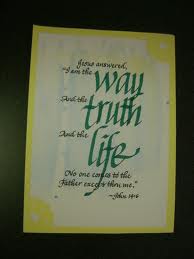
‘Except Through Me’

I am not a universalist. I do not believe that God will save everyone. He would have liked that (2 Peter 3:9), but that same verse makes it obvious that “not perish” is conditional upon “repentance.”

However, I am not fully convinced that when Jesus says ….

“I am the way and the truth and the life. No one comes to the Father except through me” ~ John 14:6

… that He means “If you have not heard of me and therefore have not believed and done all the other things that a church tells you to do to express your belief in Me, you are forever lost and condemned to eternal punishment.”

What if He means by “no one comes to the Father except through Me” is that He is the one who decides who’s in and who’s out?

Romans 2:16 and 2 Timothy 4:1 strongly imply that both God the Father and Christ the Son are involved in judgment at a day yet to come. Acts 17:31 agrees. While “the Lord” could refer to either of them a few verses down in 2 Timothy 4:8, Paul specifies which Lord, the Lord who will be appearing: Christ Jesus. And in 2 Corinthians 5:10, Paul speaks of the “judgment throne of Christ.” Without doubt, Matthew 25 puts Jesus on that throne – in His own words.

In fact, the whole of Romans 2 deals with the subject of people judging each other and how unwise that is in view of the fact that God’s judgment through Christ awaits us all. He will judge based on truth (v. 2) – and we know that Jesus is the Word, the Truth (John 1:14; 17:17; and 14:6 above).

He is also life itself, and like God, gives it and renews it to whom He wishes (John 5:21). (In fact, read the whole of John 6 for a fuller picture. Add to that reading list John 10:28 and John 17:2 and Romans 8 for more about by Whom and how that life is given. And throw in 1 John 5 for good measure.)

Is it possible that when Jesus says “no one comes to the Father except through Me,” He is talking about Who He is, what authority and influence and power He has … rather than something that is required of people in response to a truth they perhaps have not even heard, or maybe just haven’t fully understood?

A Short Post About Hell

I can’t really wade into a discussion about hell, because my theological hip boots don’t go high enough.

The Bible doesn’t say a lot about hell, and in it, Jesus says more than anybody else.

That’s kind of how I’d like to leave it. Hell isn’t for everybody, we can be sure, and it doesn’t seem to have been designed for any of us – but rather for the devil and his angels: An eternal place of punishment for eternally rebellious beings. That doesn’t describe us mortals whatever amount of rebellion we display; among us, one day, every knee shall bow and every tongue confess and rebellion will end.

To date, the most persuasive item I’ve read about hell is Edward Fudge’s The Fire That Consumes, and I understand that a more comprehensive edition is in the making. Even so, it was more about hell than I wanted to read – and somehow, in high school, I struggled through Dante’s Inferno! Edward has a soteriological scuba suit, compared to my little yellow galoshes, and that suits me just fine. Paraphrasing Karl Barth, I’ve often said that my theology rarely goes deeper than “Jesus loves me; this I know” … and it rarely needs to.

Which brings me to my point, since I said I’d try to be short.

I don’t like to think about hell. I don’t want it to ever become a motivator for my good behavior.

I want to go back to the childlike innocence that I had when (I can still remember) fighting back tears before the very first smack of a spanking or harsh word of reproval reached me because I knew I had disobeyed – and disappointed – someone I loved and respected.

I don’t want to even have to imagine looking up into the big eyes of the big God who loves and gives Himself for me – even to death on a cross – and knowing even for an instant that I’ve turned my back on that love and walked away; gone my own way instead of His; hurt people I love and whom He loves more.

I want that singular, hopefully hypothetical microsecond of unfathomable regret to be hell enough for me, and forever enough for anyone.

So I’ll keep talking about what Jesus talked about, far more than hell or sin or failure or remorse: a Father in heaven who loves without ceasing and gives without measure and forgives without a second thought or the slightest capacity to hold a grudge.

I’ll keep on describing the God who gives His Son, His Word, and His very own Spirit to help us understand how good He is … and how good it is to give until you are nearly emptied of self and filled with His nature and character.

I’ll go on talking about the God who runs to the returning prodigal, shoulders the cross, receives the nails and breathes His last surrender to supply what we desperately need the most.

There may indeed be people who are at least temporarily beyond the reach of love, and must first be drained empty of self by the evil that is sucking life out of the world around us.

There may be people who need to understand the ultimate consequence of evil and insist on having the reality of sinleadstodeath sinleadstodeath sinleadstodeath rubbed in their own eyes and faces by their own hands until they have seen enough hell on earth to want no atom of it in eternity.

There may even be some who, to their dying breath, would echo Milton’s consummately selfish motto for Satan, the Accuser: “Better to reign in hell than to serve in heaven.”

But I sure as hell don’t want to be one of them.

The Missing ‘Only’

I have a theory. My theory is that legalistic Christian thought is absolutely, incontrovertibly “right” … if you’re allowed to insert the word “only” wherever desired in scripture.

And if you’re allowed to ignore or explain away any other scripture which contradicts you.

Because if you insert the word “only” into a scripture, it can become the sole criterion for something to be true; the singular condition upon which a logical progression can be made.

And the genius of legalistic Christian thought is that the word “only” doesn’t even have to be expressed as part of a verse being quoted or a logical constructed being built … it’s assumed.

All thanks to the doctrine of the silence of scripture: Anything not expressly commanded is implicitly condemned.

Want to exclude the active, current, present role of the Holy Spirit in faith? Quote Romans 10:17:

So then faith cometh by hearing, and hearing by the word of God.

Because the verse is silent on any other way by which faith comes, there is no other way. Faith only comes by hearing. (Of course, you have to ignore or explain away 1 Corinthians 12:9 and Ephesians 2:8, but those are relatively minor inconveniences.)

The problem, of course, is that the word “onlyisn’t there.

And most legalistic Christians would be quick to point out the condemnation attached to this passage:

I warn everyone who hears the words of the prophecy of this scroll: If anyone adds anything to them, God will add to that person the plagues described in this scroll. And if anyone takes words away from this scroll of prophecy, God will take away from that person any share in the tree of life and in the Holy City, which are described in this scroll. ~ Revelation 22:18-19

“Faith comes only by hearing” is just one example of “the missing only” fallacy. I’ll bet you folks have encountered lots of others.

Share a few!

The Visitor

It was a cold day at the close of February, even as far south as Hinterlands, Texas, and those who gathered there for the Disputing for the DoctrineTM Lectures were grateful for a warm church building.

A few minutes before the first lecture was to begin that Sunday morning, a smiling visitor in a three-piece suit and carrying a clipboard took his place behind the lectern and the crowd quieted out of curiosity.

“Thank you,” he greeted. “I won’t take much of your time; I’m just here to take an informal survey of sorts and a quick show of hands will take care of the answers I need.

“The theme for this year’s lecture is ‘Portraits of Heresy #2,’ which makes me assume that last year’s theme was, of course, #1. I see from the program that it consists of refutations of books, sermons and other works by others within the fellowship.

“First question: Has anyone contacted any of these authors directly to discuss with them any difficulties they may have had with the content of those books before preparing his remarks here? Anyone? Show of hands, please.”

The visitor looked as perturbed as the people in the audience. No hands went up.

“Okay,” the visitor acknowledged, and wrote something on his clipboard sheet. “So we have a potential procedural violation of code 40.18.15-17 and 40.5.23-24.

“Got it. Second question: How many of you can name all of the false teachings, heresies and apostasies described the New Testament? Hands?”

Again, though there were no hands going up, there was a considerable amount of consternation apparent.

“I’m not going to ask you to list them all; I’m just asking if you know them all,” the visitor smiled sympathetically. Looking about, he saw no response and inscribed another character on his clipboard sheet, muttering: “Complete unfamiliarity with 48.5.6, 54.1.3-10, 61.2.1, 62.4.3, 63.1.7 … and all the rest.”

“What are you talking about?” hollered a fellow sitting near the front, trying to rise to his feet and suddenly finding himself unable to do so.

“Oh. Your legs have fallen asleep.” The visitor appeared to consider it. “Appropriate. – I’m talking about law. You do consider scripture to be law that must in every case be fully known and obeyed, do you not? No, no; I wasn’t asking for a show of hands on that one. – What I’m doing is simply expressing scripture as citations of law; I thought that might be your preference. I’ll convert back, if it will make things clearer. Third question: Everyone’s aware of, uh, Matthew 7:1-2 … ‘Do not judge, or you too will be judged. For in the same way you judge others, you will be judged, and with the measure you use, it will be measured to you …?’ How many of you believe that does not apply to you because you are, in fact, disputing for the doctrine?”

Thunder sounded outside, a little more threateningly than it had before.

A few hands started to go up, but there was some confusion over the phrasing of the question and they quickly went down. A middle-aged fellow jumped to his feet and shouted, “Listen here … Who are you? What gives you the authority to …?” But his question was interrupted when he suddenly gasped, clutched at his chest and sank back into the pew dumbstruck.

The visitor’s smile had faded. “Ouch. Chest pain? Heart, I’ll bet. Perhaps you should take it easy. – I must compliment you on intuiting the subject of the last two questions, by the way, identity and authority – although in reverse order. Fourth question: How many of you believe that everything regarding worship and service to God must be specifically authorized in scripture ….” At this, virtually every hand shot up and even the cautious ones – seeing the majority vote enthusiastically – joined eventually. “… and that anything not specifically authorized in scripture is of sin and leads to God’s judgment and to eternal damnation?” No hands wavered, though, even as the visitor added in a clarifying tone, “Including instruments used in worship, cooperation in giving to aid the poor and widowed and orphaned, purchased places of worship with heating and air conditioning units …?”

Outside, the storm was audibly growing closer, and the snowflakes falling more furiously beyond the stained-glass windows.

Counting with his stylus, the visitor etched what must have been simply a rough estimate of the total attendance on his clipboard sheet. “Thank you; last question. This is a purely hypothetical one, of course: If I just happened to be an angel of the Lord, can anyone here give me even one reason why I should not call down fire from heaven to consume this place and all who are in it?”

That was the last straw; dozens of people launched themselves in the general direction of the lectern at the front. Shouts began: “Now see here!” “You have no right!” “Stop this very…” But at that very moment, a colossal flash of lightning through the windows whitened the image of every soul present and a simultaneous sonic boom of thunder pounded the rafters, the pews, the floor, and the center of each heart there. Though the lights flickered out, they did not stay out – yet they returned much dimmer. There was a sizzling electrical noise nearby that died out a few seconds later, and the hint of a scent of smoke.

As the crowd looked around, they realized that the visitor was gone from the lectern. No one had seen him go during the instant of brilliance and then darkness. He simply was not there.

The host of the Lectures rose to his feet, his knees still a bit wobbly from having just regained prickly wakefulness. He took his place at the lectern and said haltingly, “Well … heh, heh … that was unusual, wasn’t it? Can’t ever remember a Lecture beginning quite like that before; can you?”

There was some nervous laughter. He reached for a song book. “Well, let’s sing a song to begin.”

As the strains of Will the Circle Be Unbroken filled the auditorium, punctuated at the end of nearly every phrase by staccato thunder, the sense of anticipation returned … though this time, with a good measure of apprehension. Eyes occasionally darted up to the ceiling, creaking under the weight of newfallen snow, or toward the windows as thunder sounded. And the warmth in the auditorium slowly seeped away.

Which was no great mystery; the bolt of lightning had fried the HVAC unit out back.

How to Make a Church Grow

Don’t try.

Okay, that would be my first post shorter than its title, but I’m tempted to leave it at that.

Here’s what I mean, though:

Don’t make church growth your goal.

Make your goal preaching Christ, making disciples, putting people to God’s work with the help of His Holy Spirit.

The church that results from that will grow, if the seed finds receptive soil and God gives the growth. Keep watering. Plant more seed; the Word — you know.

Don’t worry about uplifting worship times, awesome praise teams or incredibly gifted worship bands or dynamic speakers or cool videos or  special programs or targeted ministries or awesome marketing or a big, sprawling building or sufficient parking or offering seeker services or traditional services or progressive services. Some of that may come, but fend it off as long as you can.

Tell them about Jesus. Show them Jesus. Win them to Jesus. Demonstrate to them how they are visiting Him in jail; how they are clothing His nakedness and feeding His hunger. When they have worked side by side with each other and with the Spirit, they will want to gather in praise, as often and as devotedly as possible.

People who can see the work of God – the work He is doing through them; in partnership with them – when they see that work in the lives of others … they’ll see it in their own lives too and you won’t be able to shut them up when it comes time for worship. Or any other time. It will well up from within them like a spring of living water. Just stand back and thank God when it happens and you get caught in the spray.

You may not be able to limit them to just meeting on Sundays to worship together. They might just open their hearts and their homes and their dinner tables and their earnings to each other. They might sell their possessions and give to those who have need until no one among them has need anymore.

I know all this sounds too good to be true. I know it sounds like a pipe dream. I know it sounds all but impossible.

But it also sounds a lot like the last few verses of Acts 2, and well into Acts 3 and 4.

And it also sounds like what Jesus said about nothing being impossible with God (Matthew 19:26; Mark 10:27; Luke 18:27).

Why The Bible Doesn’t Legislate Song

A few possible reasons, anyway.

Of course, you need to understand that I don’t believe that singing praise is necessarily commanded in the New Testament. Nor is accompanying it when one does sing. Nor is singing / accompaniment forbidden. Singing is encouraged; singing is exemplified; that’s all. So you may need to visit some of my other posts first, before you object to the current one.

First of all, if God commanded everyone to sing with heart and voice, it would be impossible for people who have no vocal cords to obey, and there are all kinds of reasons why people don’t have vocal cords, from birth defect to injury to surgical removal due to cancer. It would also be impossible for a mute person to obey; someone whose neural network doesn’t connect like most folks’ do in the speech and communication area. God doesn’t seem to be in the business of excluding people in the kingdom described in the New Testament. He once excluded eunuchs from His tabernacle, but not from His kingdom. (It was even prophesied in Isaiah 56, a chapter which writes in the formerly exiled.) Surely there a but a few people who cannot sing in either heart or voice – and fewer still who cannot be uplifted by hearing or seeing it (as would be the case of many deaf people who still seem to thoroughly enjoy the rhythmic interpretation of ASL, for instance).

Secondly, if New Testament scripture legislated singing, that sort of law would have to get into all the details about how to sing; whether to sing with accompaniment; what kind of accompaniment is permissible … and so on and on and on. Instead, we have instructions that encourage us to sing together, praise together, build up each other. We have an example where that happened in a dark jail cell in Philippi, where required accompaniment on an instrument would have been likely impossible to obey. Christians being hunted down for lion fodder in the late part of the first century (and later) would have given away their location in the tombs had they worshiped in celebratory song accompaned by loud instruments. On the other end of the spectrum, we have an example or two in a vision of heaven where God gives each saint a harp and voice and where a cappella singing probably would not be required. Heaven is free from threat; enough harps are played that it’s as loud as an ocean or thunder. It doesn’t make sense to require instruments where they are not needed nor forbid them where they are useful.

Thirdly, there are times when people don’t feel like singing – at least, not like singing songs of joy and adulation and exuberance. Captive Israel didn’t feel like singing when dragged away from their homes to Babylon, and there on the poplars they hung their harps (Psalm 137). You can’t wring blood from a turnip. And you can’t wring songs of joy from a depressed heart. Scripture recognizes that. The Holy Spirit of God recognizes that, when inspiring such lamentations. In fact, there’s even a short book of them right there in the Bible. Paul even instructs us: “Rejoice with those who rejoice; mourn with those who mourn” (Romans 12:15). Maybe our worship, its planning and expectations of others during it should recognize this as well.

Fourth, if we take the Lord at His Word to Mary through the angel or through Jesus to His disciples – that with God, nothing is impossible – then He could just as easily tune out the sound of instruments He might not want to hear today as easily as He could refuse to listen to them in the disobedient days of Amos 5:23. In fact, if there is anything that this chapter makes clear, it is that God is concerned about the hearts and lives of those who worship Him in song; if those are not right, those songs are just “noise.”

If there is anything that approaches legislation in scripture about singing, that’s it:

So what shall I do? I will pray with my spirit, but I will also pray with my understanding; I will sing with my spirit, but I will also sing with my understanding. ~ 1 Corinthians 14:15

… speaking to one another with psalms, hymns, and songs from the Spirit. Sing and make music from your heart to the Lord, ~ Ephesians 5:19

Let the message of Christ dwell among you richly as you teach and admonish one another with all wisdom through psalms, hymns, and songs from the Spirit, singing to God with gratitude in your hearts. ~ Colossians 3:16

Is anyone among you in trouble? Let them pray. Is anyone happy? Let them sing songs of praise. ~ James 5:13

I think perhaps there has been so much emphasis on the imperative nature of the word “sing” (and on the interpretation of it as a command) that we have virtually ignored the modifiers which address the spirit, the mind, and the heart. Singing is not something done with just the body; the larynx, tongue, lips and lungs … the fingers, hands, arms, and feet. As worship, it is something that pleases God and expresses love and builds us up – like everything else – when it is done with all one’s heart, soul, mind and strength (Mark 12:30). This isn’t so much command as common sense.

What is the point of worship if it is not felt within as well as expressed without? What meaning is there in it if it is done solely as an obedient response; an obligation; a requirement to be carried out out of fear or duty or both — or just habit?

What would it look like if the spectators at a sporting event or the audience at a rock concert expressed their appreciation because they were told they had to; it was expected of them; it was customary? That it didn’t matter how well it went or how they felt about it or whether they felt anything about it – just respond or else? And they are to respond only by nodding quietly or repeating a soft-spoken approval while seated in a very restrained fashion; no applause; no standing; no variation; no innovation permitted?

Who would go to an event like that? Who would pay to go to an event like that?

(Yet we hope people will flood into our churches in droves, with generous hands doling cash into the collection coffers!)

Fifth: Maybe song isn’t legislated because song isn’t always given. In scripture, songs are given and called forth by God (Psalm 40:3, Psalm 42:8, Psalm 65:8; Job 35:10, etc.). Can God expect in return from us what He has not first given us? Perhaps the time is not appropriate for song; a time to weep rather than laugh; a time to mourn rather than dance (Ecclesiastes 3). Still, there is a time for song, and surely God knows when to give it. The fact that songs are often given by inspiration may help account for the fact that the phrase “new song” occurs so many times in scripture.

Sixth – and then I’ll step down from my soapbox and prepare to be pelted with all of the objections that can be gathered and slung – perhaps the Bible doesn’t legislate song because song has so many purposes and uses:

If the legislation required loud volume and jaunty pace, the songs of mourning would not sound right. If a song-law demanded softness and deliberation, then the exuberant songs that should burst forth from man, beast and nature itself would be defeated. If instruments were commanded for all, how could the song of a single soul walking in the woods or hanging out wet laundry be worship; if accompaniment were forbidden for all sorts of song, how could the “Hallelujah Chorus” achieve its full glory?

Like the Sabbath, song was made for man rather than the reverse. It is a gift of God to help us express what we feel toward Him and to the uplifting of others.

All right. That’s pretty much the extent of my wisdom on the matter. God’s wisdom exceeds it considerably. And that keeps leading me to the conclusion that songs of worship and praise and edification are encouraged by scripture – rather than regulated, codified, decreed, systematized, criminalized, enforced, prosecuted, sentenced and convicted.

Re-post: Preaching Jesus

Sorry. I have no idea why I feel compelled to re-post this from not-quite-a-year-ago. But here it is.

Take a look around on the Internet at the orders of worship and sermon topics of churches which post them, and you might get the impression that many ministers of the gospel have the idea that “You can only preach so much Jesus.”

Really?

Because you can preach “the plan” all you want to, and if you don’t preach “the man,” you’ll have converts to a system, not the Savior.

You can preach “the church” all you wish, and if you don’t talk about the Bridegroom who purchased her with His blood, you’ll be preaching narcissism.

You can preach against sin all year every year, and if you don’t proclaim the One who died to save us from it and lived again so that we could live, you’ll only be spreading guilt and despair and hoplessness – not the gospel.

You can preach about your experiences in life till the cows come home, but if you don’t share His, will your church end up knowing more about your life on the farm than the Son you live for?

You can preach about biblical history, eschatology, pneumatology, soteriology, theology, or any other -ology … but if you don’t tell people about Jesus of Nazareth and what He taught and how He lived and how He reigns, just exactly what are you doing in the pulpit of a church in the Christian faith?

Have you actually shared all there is to know about Jesus of Nazareth, Son of God, Son of Man, Savior, Redeemer, Rabbi, Teacher, Lord, Master, Friend, High Priest, Sacrifice, Good Shepherd, the Holy and Righteous One, Firstborn of the Dead, Wonderful Counselor, Mighty God, Everlasting Father, Prince of Peace? The One to whom virtually all scripture points and praises – like John, His cousin – “Behold the Lamb of God who takes away the sins of the world!”

Has your church plumbed the depths of its relationship with God through Christ?

Have you told them all there is to know about His love; how far He would go and what He gave up?

Or have you given up?

Paul didn’t give up, and Christ was all he resolved to preach (1 Corinthians 2:2).

Peter knew there was no other name that could save (Acts 4:12).

John knew that it is through Him that we have fellowship (1 John 1:5-7).

Not just a plan. Not just a church. Not just a history. Not just a theory of His return, His Spirit, His divinity, His salvation, or His relationship with His Father.

But HIM.

Have you actually worn out the Ancient of Days?

Have you truly out-taught the Teacher?

Have you really mastered the Master?

Now there were some Greeks among those who went up to worship at the Feast. They came to Philip, who was from Bethsaida in Galilee, with a request. “Sir,” they said, “we would like to see Jesus.” ~ John 12:20-21

Prisoner for the Lord

Joseph son of Jacob was one. So was Samson. Most of the children of Israel, in Egypt and Babylon. Jesus Himself. Peter and John. Eventually, almost all of the apostles … and uncountable disciples and martyrs thereafter.

But it was Paul who put the reality into words: “Prisoner for the Lord.”

He was one. And so am I. And so are you.

Not locked into manacles and chains of a physical jail cell, but constrained by self-restraint and the Spirit of the Lord to live a life of service to others and therefore to Him.

Or locked into a life that serves self and sin and therefore, Satan (2 Timothy 2:26).

Slavery. Indentured servitude, if you prefer, since it is by our choice. And it is our choice.

Don’t you know that when you offer yourselves to someone as obedient slaves, you are slaves of the one you obey—whether you are slaves to sin, which leads to death, or to obedience, which leads to righteousness? ~ Romans 6:16

It’s one or the other; no middle ground. Romans 6-7 leaves no doubt about it. One choice leads to eternal life in Christ; the other to death.

Inevitably, the sentence is death. Either to self and our own desires (Galatians 5:24; Ephesians 4:22; Colossians 3:5) or of self and our own desires.

My favorite television show as a kid was the brilliant and enigmatic (but short-lived) British series The Prisoner. Its nameless, titular main character began each episode with a defiant declaration to his captors: “I am not a number; I am a free man!”

Scripture says choose self and you are just a number … one of the numberless multitudes who are prisoners to their own desires yet whose hairs are numbered and known by the Father who loves them; choose the Father and you are free from law and death and sin and self.

You become the warden, taking captive “every thought to make it obedient to Christ” (2 Corinthians 10:5).

You also capture His heart, as you are captivated by His love.

And forever after, you are free to be a prisoner for the Lord.

You Can Pray

There may be a lot of things you can’t do to relieve suffering, help others, make the world a better place, proclaim the gospel or work toward the inbreaking of the Kingdom of God.

But you can pray.

You can pray for your fellow commuters, fellow workers, customers, clients, patients, suppliers, visitors, office neighbors, family, friends, church, city, state, nation, world.

You can pray for newborns, babies, toddlers, children, pupils, students, graduates, applicants, candidates, professionals, laborers, retirees, the aged, the dying and the dying inside.

You can pray for the healthy, the ill, the confused, the distressed, the hungry, the hopeless, the helpless, the depressed, the damaged, the deserted, the bereaved, the forgotten, and the lost.

You can pray for the public servant, the private tutor, the teacher, the instructor, the professor, the administrator, the honest, the dishonest, the learned, the learning, the giver and the recipient.

You can pray for the pastor, elder, shepherd, deacon, servant, minister, preacher, leader, member, seeker, saint, rebel, mentor, questioner, enforcer, incarcerated, the free and the enslaved.

You can pray for people you know and people you don’t.

You can pray for your friends. You can pray for your enemies.

You can pray for angry people, hateful people, evil people, nasty people, people opposed to God, people who don’t believe in God, people who don’t want to believe in God, ever, because it might mean having to give up on their self-dependence and self-indulgence in a world that has perhaps blessed them and/or perhaps let them down in every way possible.

You can pray for justice. You can pray for mercy. You can pray for a humble walk with God.

You can pray for the Kingdom to enter hearts with force and tenderness and love. You can pray to be part of it.

You can pray for gifts for others. You can pray for gifts for yourself.

You can pray for greater understanding, more compassion, increased courage, elevated awareness of others, deeper love, heart-baring compassion, a cascade of opportunities, and a bottomless reservoir of spiritual wealth to share with all you meet.

You can pray for time and energy and willingness to use them when given.

You can pray for peace of heart, peace of mind, peace among neighbors, peace on earth, peace with God.

You can pray and pray and pray and pray.

And then you can be part of God’s answer.

He will answer. You may not like His answer. It may not come at the time you want it to come. It may sweep you off your feet and engulf you in a life you never dreamed possible, for your good but perhaps not for your comfort – but certainly for the good of those you encounter.

You can pray to enter into partnership with God through Christ, sustained by their Holy Spirit, to do good works that He has created beforehand for you to do and for which He created you.

You can pray timidly or dangerously.

You can pray for healing for others, but you can pray for healing for yourself, too.

You can pray that others will be blessed with greater insight and understanding of God’s will for them, but you can pray that for yourself, as well.

You can pray morning, noon and evening. You can pray without ceasing. You can live your life as a prayer, a sweet-smelling savor of incense burning in the hearts of God’s saints, pleasing to His senses.

You can.

You can.

The Holy Spirit and the Church, Part 2

I’m going to phrase this as carefully as I know how:

I believe a church that focuses on the Holy Spirit and gifts from Him can still go way wrong, just as an individual gifted with His presence in their lives can go way wrong. (Consider King David and Psalm 51, for instance.)

In a previous post (The Problem With Tongues), I’ve already shared my opinion that one of the problems that had cropped up in the church at Corinth was that jealous, selfish-minded people were faking the Holy Spirit’s gifts in order to gain attention. I can’t and won’t say that the problem persists or is widespread to this day, because my experience with churches fastened on the Holy Spirit and His gifts is meager.

But I will say that I can’t imagine how someone reading the first epistle to Corinth (as our Bibles label it) could see a pattern there for the way God would prefer and order the gathered worship of His saints.

There, the attention given to individuals with certain gifts had created or worsened a problem of jealousy and division (evident in the early chapters), and perhaps had contributed to the demotion of the importance of their time in remembrance and proclamation at the Lord’s table (evident in chapter 11), and was contributing heavily to the chaos taking place in their gathered worship (evident in the following chapters).

I continue to propose that fakery was going on in that church, but I would be quick to point out that wasn’t the worst of their problems there.

The focus in their worship was on themselves, and not on Christ – that was the chief and root problem.

In studying the purpose and nature and personality of the Holy Spirit, one cannot escape the conclusion that He is all about glory being given to God through Christ. He doesn’t even have a name of His own, His nature is so humble. As nearly as I can tell (unlike the Father and the Son), there isn’t even a gender associated with Him, and we use the masculine one regarding because English doesn’t have a gender-neutral pronoun for people. And it just sounds disrespectful to refer to Him as “It.” (I am wholly unschooled in biblical Greek and eagerly willing to be corrected on that perception by someone who is conversant in it, however.)

The point remains that the focus of worship is not gifts or even the Spirit as giver, but on the Lord God Almighty. Jealous of each other must give way to love of each other in view of God’s jealousy regarding our hearts. Self must be dethroned so that God may be enthroned there.

It’s the selfless heart who can be trusted with great and powerful gifts from the Holy Spirit. Because it is the selfless heart who uses those gifts to the benefit of others and the glory of God, not himself or herself.

I have said before that I would be the wrong choice as a recipient of a gift of healing others. I would never rest, spending all my time at hospitals and clinics, doling out perfect health for as long as I could because I cannot bear to see others suffer. In fact, I’d start at Arkansas Children’s Hospital because seeing children suffer just kills me and I would do everything I could to put a stop to it. Would I take time to nurture the wounded souls and spirits of those around? Tell of Jesus’ love for them? Speak to them of immersing themselves in the kind of life He lived and wants to live through them?

I don’t know. I am not proud to say that. I am afraid that I would not; as an untrusting yet believing soul, I fear that would simply spend that gift as if it had a finite quantity – before it ran out. And the saddest part of this confession is that I would spend it just as surely for myself as for others … because of the relief it would give me, personally, each time I saw suffering relieved. Yet there could be no end to it.

I mean, it sounds unselfish – dashing about serving others?  I assure you, it would not be.

Self, of course, is not the reason that gifts are given. Any cursory study of them quickly reveals that they are not for self but for others, and to God’s glory. That’s because they are given as a result of grace:

For by the grace given me I say to every one of you: Do not think of yourself more highly than you ought, but rather think of yourself with sober judgment, in accordance with the faith God has distributed to each of you. For just as each of us has one body with many members, and these members do not all have the same function, so in Christ we, though many, form one body, and each member belongs to all the others. We have different gifts, according to the grace given to each of us. If your gift is prophesying, then prophesy in accordance with your faith; if it is serving, then serve; if it is teaching, then teach; if it is to encourage, then give encouragement; if it is giving, then give generously; if it is to lead, do it diligently; if it is to show mercy, do it cheerfully. ~ Romans 12:3-8

Jesus had extraordinary gifts, and Satan knew it. He tempted the Lord to use them to sustain, promote, glorify self rather than God. Jesus refused.

Paul was given extraordinary gifts (2 Corinthians 12:12), including tongues (1 Corinthians 14:18-19) and healing others (Acts 14:9, 28:8) yet prayed for relief from a thorn in his own flesh (1 Corinthians 12:1-10), but was given the answer that God’s grace was sufficient for him. It is not our gifts which are our glory, but our suffering (Romans 5:3; 8:18). It is a hard, hard lesson.

Finally, to seal the point I hope to make, there are greater gifts (1 Corinthians 12), but they are the ones which clearly benefit others and the church as a whole: apostolic leadership, prophetic proclamation, humble teaching … and then the others. All are to be used to God’s glory.

And not our own.

That’s why gifts are not commanded, but given.

That’s why they are given at God’s discretion, not ours.

That’s why they are not signs or marks of the Spirit’s presence for one’s own assurance, but for the power of turning others’ hearts to God. (2 Corinthians 5)