What Chaps My Saddlebags

Do you know what really chaps my saddlebags?

Of course you don’t – or if you think you do, you’re still reading to find out if you’re right.

What really chaps my saddlebags is people who think they know God better than He knows Himself.

There. I’ve said it. And I ain’t a-gonna take ‘er back.

I’m talking about people who say, “Oh, the Bible is bad because it mandates war and extermination and intolerance.”

Well, tough toenails, Person-Who-Knows-Gooder-Than-God. Tell you what. You pretend you’re God. You devise a brilliant way to keep order among millions of refugees in a desert with no visible means of support for forty years and if you come up with something better than law and punishment and providence, you give me a call.

And if you find something more efficacious than Christ’s blood and His grace in giving it for all who mature past the point of needing law, make it an urgent call, collect.

While I’m waiting, I’ll just go on yapping about people who say, “God is hateful and murderous and vengeful.”

Well, duh. He is also just and merciful and loving and provident and generous and omnipotent. Try telling the whole story in context instead of just the part that suits your purpose. Imagine holding back all of your emotions at those whom you might have created to enrich the world when they molest and rape and torture and steal and lie and annihilate each other instead of doing what you asked them to do, which was for their benefit and the good of all. I’m just real sorry He doesn’t measure up to your perfect standards of morality.

Oh, and by the way, see how you feel when they nail your firstborn to a cross and leave him there to die.

In the meantime, keep to yourself your brilliant perceptions about what the Bible says until you’ve read it through at least once, and about who God should be like until you’ve achieved perfection yourself.

He will still love you no matter how idiotic your notions are, and will still want you to be a part of His family in spite of what you are:

A doofus like me.

I know, because I’ve had some of those same snot-nosed, arrogant, indefensible ideas myself – probably still carry a few of ’em around in my saddlebags, when I’m thinkin’ with ’em as well as just sittin’ on ’em.

And He still forgives.

‘Love Wins’: A Brief Impression

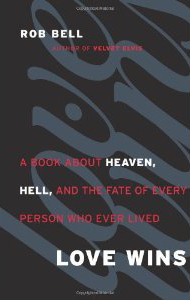
Love Wins by Rob BellMaybe it’s because I purchased Rob Bell’s controversial short tome Love Wins: A Book About Heaven, Hell and the Fate of Everyone Who Ever Lived this morning and devoured it whole by early this evening, but “A Brief Impression” is all I can yield.

I like Bell’s writing style. I’ve used it for years, not even knowing that he would be born and grow up to use it himself. I like asking questions, especially leading questions, as I find that was a tactic favored not only by some influential Greek philosophers, but also Jesus Himself. It’s good to encourage folks to think for themselves.

But if I’m ever going to write a book “About” something, I hope I will give that something the treatment it deserves, rather than just a quick overview outlining the aspects I like and the reasons why I like them. I hope I’ll give a little fair time and reference to the aspects other people like or prefer and their reasons, and if I disagree, maybe some of the reasons why I disagree.

If that something is a matter of faith, I hope I’ll cite a lot of scripture illustrating many points of view and why I’ve settled on mine.

And if I’ve raised a lot of questions, I’d like to hope that I would try to give my answer to at least more than a token few of them.

Satan, for instance, only makes a cameo (pp. 89-90) in Love Wins, and by reading scripture you’d think he had something more to do with sin, fallen man, temptation, judgment, and final destiny than just the function and perhaps destiny to make people better by having them turned over to him for whatever he does with them. However, there is no mention of his other appearances in scripture.

This is just one example, and I’ll leave it at that because I’m trying to keep this impression brief and I find that example typical of Bell’s treatment of his subjects in Love Wins. (The word “salvation,” for instance, only appears about 10 times – once in the ISBN description of the book, oddly enough.) Fortunately, he doesn’t burden the reader with terms like penal substitutionary atonement or soteriology.

I actually sympathize with Bell’s charge that the story of Jesus has been co-opted for a lot of different and lesser stories, some of them patently false – but to be able to call them false, one would have to refute them. And he doesn’t. Nor does he really, definitively support the propositions that he seems to be suggesting.

I can’t sympathize with the ideas that heaven and hell are merely states of mind in this life (or aeion) enjoyed by or inflicted upon one’s self through the choices one makes, or that because God desires something – the salvation of all – He makes it happen by His irresistible love, even perhaps against the will of one who does not wish to be saved. Those may not even be accurate perceptions of what Bell was trying to say. (And I end up having more questions. Like, “Does justice win, too?”)

You see, conclusions of this nature are rarely stated as such in the text of Love Wins. One is left to draw one’s own conclusions … which is another part of the writing style I share with Rob Bell. Yet, to be able to do so, one needs enough information on all sides of a question to reach a conclusion.

Rather than a brief impression.

To be fair, at the close of the work, Bell suggests other and weightier references from which he has gleaned some of Love Wins. Hopefully, they discuss the questions and issues raised within it more fully. And I fully appreciate the need for a work that addresses them without becoming ponderously heavy.

I’m just not sure that Love Wins really addresses them.

Resurrected or Resuscitated

When my dad passed away the first time, eighteen years ago, EMTs came rather quickly and brought him back to life — a simulacrum of life, anyway; he remained in a coma the rest of his days and even breathed on his own for the last several of them. A couple of weeks later, pneumonia finished what his coronary episode had been cheated out of accomplishing.

For a while, though, my dad was resuscitated.

People in scripture died and were resuscitated. A widow’s son (1 Kings 17:7-24). Another widow’s son (Luke 7:11-17). A little girl (Matthew 9:18-23; Mark 5:21-43; Luke 8:40-56). Lazarus (John 11:1-43). Perhaps even a young man who fell out of a window (Acts 20:9-12). They were raised to life. Eventually, they died again.

Being resurrected is something entirely different. Jesus was not the first to return from the dead, but He was the firstborn of/from the dead (Colossians 1:18; Revelation 1:5) — and I have to wonder if this means that He is not only pre-eminent from the dead, but also the first to be resurrected rather than just resuscitated.

The resurrection body is different; it is imperishable; it cannot die again (1 Corinthians 15:52). The immediate context of that verse is revealing:

I declare to you, brothers and sisters, that flesh and blood cannot inherit the kingdom of God, nor does the perishable inherit the imperishable. Listen, I tell you a mystery: We will not all sleep, but we will all be changed— in a flash, in the twinkling of an eye, at the last trumpet. For the trumpet will sound, the dead will be raised imperishable, and we will be changed. For the perishable must clothe itself with the imperishable, and the mortal with immortality. When the perishable has been clothed with the imperishable, and the mortal with immortality, then the saying that is written will come true: “Death has been swallowed up in victory.” ~ 1 Corinthians 15:50-54

May I propose that this change does not necessarily apply to everyone, but to “brothers and sisters” whether they “sleep” or not? That “the dead” refers to the dead among the believers, not all of those who have died? Because “the perishable cannot inherit the imperishable,” perhaps those who have not been obedient are – at the day of judgment – not resurrected at all, but resuscitated? Given back their mortal forms in order to stand at judgment as well?

I don’t intend to be dogmatic about this; I’m just proposing it.

Unconvinced? That’s okay. It’s not a test of fellowship. It’s a proposition. But consider the verses of the larger context, immediately before these just quoted:

So will it be with the resurrection of the dead. The body that is sown is perishable, it is raised imperishable; it is sown in dishonor, it is raised in glory; it is sown in weakness, it is raised in power; it is sown a natural body, it is raised a spiritual body.If there is a natural body, there is also a spiritual body. So it is written: “The first man Adam became a living being”; the last Adam, a life-giving spirit. The spiritual did not come first, but the natural, and after that the spiritual. The first man was of the dust of the earth; the second man is of heaven. As was the earthly man, so are those who are of the earth; and as is the heavenly man, so also are those who are of heaven. And just as we have borne the image of the earthly man, so shall we bear the image of the heavenly man. ~ 1 Corinthians 15:42-49

That may or may not mean that “earthly man” refers to those who will not obey. It could, as is usually understood, simply refer to our mortal forms — whether believer or not. I’m speculating. I acknowledge it again.

But this could explain how all will face judgment – no matter what degree of decay or even atomization their mortal form may have taken (Revelation 20:11-13) – yet the disobedient can be destroyed (2 Thessalonians 1:9; 2 Peter 3:7) while those given grace also receive immortality (2 Timothy 1:10); eternal life (for the aeonsMark 10:30; John 3:16; John 5:24; John 17:2; Romans 2:7, etc.)

And the last enemy to be destroyed is death (1 Corinthians 15:26).

Scriptural Salvation: Loss-Gain Analysis

In the last couple of posts,* I’ve outlined what I find scripture to say about salvation … and what it doesn’t say. I do not read it saying that everyone who does not hear the gospel of Jesus Christ is automatically lost and doomed to an eternity of torment – any more than it says that in the final judgment, everyone will be saved.

Those are extreme readings of scripture. Both require some rather torturous logic to reach them. The truth, I believe – as is almost always the case – lies between the extremes. But where?

Where scripture has led me is to a God who judges through His Son, and who judges the works of all. Those who have heard and believe in Jesus, the Christ and Son of God, have faith and the gift of His Spirit to inspire them to good works, which testify to their faith as surely as their words do. Those who have not heard still have a kind of built-in moral compass which should lead them to deduce the existence of God from the good works He has created, and to desire a life marked by good works as well.

Still, there will always be those who will turn their backs on everything good – whether they know the Name for it or not – and live a life full of self … which ultimately becomes self-destructive.

What do we as believers lose and what do we gain from adopting these conclusions, as opposed to more traditional extremes?

We do not lose conformity with scripture.

We do not lose the urgency of the great commission; the importance of the gospel.

We do not lose the sovereignty of God, nor His justice, nor His mercy, nor His desire that we choose the One who has chosen us.

We do lose a picture of a “God” who vengefully tortures – eternally – those who have never heard of Him, or do not fully understand him, even though they may have led very moral and generous lives marked by very few sins of a temporal nature and influence. This is a picture which sees only His justice, but little or none of His love and mercy.

We also lose a view of a “God” who capriciously says He was just kidding about justice for martyrs or victims or slaves; who yawns that it doesn’t really matter what you did or what you believed or how important you thought you were; who winks that you’re loved now and you have the right perspective about Who’s in charge and so you’re saved. This is a view which describes only His mercy, but little or none of his righteousness and justice.

We gain a glimpse of a God who perfectly balances justice and mercy; a God inarguably fair; a God who – even when meting punishment – does not over- or under-prosecute. (See Luke 12:35-48 regarding how unfaithful servants are to be treated. It does not speak of those who are not servants.) Nor does He over- or under-reward, since the work of salvation is His work. (See Matthew 20:1-16 regarding how servants working for short or long spans are to be treated.)

And, I believe, that glimpse is a much more balanced, realistic, accurate – and heart-winning – conception of God. Yet, the fact is, He has chosen to do that winning through us when He could have done it any way He desired.

So another thing we have to lose is our arrogance. (And I mean we have to lose it. We’ve got to.) We can no longer hold it over the heads of those who have not heard the truth of Christ that we have something  they can’t have unless they do what we tell them to do. You see, it too often sounds like that to someone who has not yet heard the full Story. It sounds like a power play. It sounds judgmental. It sounds exclusive rather than inclusive. And it does not sound genuine. (No wonder. It’s not.)

At the same time, the other thing we have to lose is our own complacency. Not everyone is going to be saved. There are those who will themselves not to be saved, as well as those who are most willing if they only knew why and how and Who. And the Story of Jesus, the perfect example of selflessness and self-sacrifice, when humbly shared has great power to turn hearts toward God, toward good, toward belief and a life marked by good works that draw still more to Christ. It is important, because to those who have heard and believe, the promise of salvation is sure, written in blood.

So the final thing we should and must lose is self. We have to become the Story (Galatians 2:20). We have to learn to balance love/mercy with justice/righteousness in our own lives. All of our words alone will not do what must be done, nor are all of the good works we can do sufficient to communicate the Story. We must tell it. We must live it. If we who believe and act justly and love mercy will commit to walking humbly in this way with our God (Micah 6:8), we have something extraordinary to gain:

The fellowship of the souls around us whom we love – and whom God loves even more.

He has given us everything we need to live and speak the truth in love and win them, even the time in our days. Yet that time is a limited commodity:

The Lord is not slow in keeping his promise, as some understand slowness. Instead he is patient with you, not wanting anyone to perish, but everyone to come to repentance. ~ 2 Peter 3:9

I believe they have a chance, even not knowing Him. But the odds of repentance and therefore salvation weigh so much more heavily in their favor when the possibility becomes a promise.

____________

*Salvation: The Short Course and ‘Except Through Me’

Salvation: The Short Course

It is a sure thing for those who believe in Christ (Ephesians 1:13-14) and repent (2 Corinthians 7:10) and love and obey (1 John 3:10). That certainty is stated in the form of a promise (Mark 16:16) which is conditional – because those who do not believe will obviously not repent nor love nor obey.

Clearly, those who have believed and obeyed must have heard or otherwise encountered the truth they have accepted (Acts 4:4; Romans 10:14). But there is no scripture I’ve found which excludes from salvation those who haven’t heard and therefore could not believe. They can have no hope of it, since they have not heard of the promise to believers. But believers and those who don’t believe will be judged in the same way – by what they do (2 Corinthians 5:10; 1 Peter 1:17).

Salvation is something Christ has finished (John 19:30), but it is also something He has not yet returned to bring to those who are awaiting him (Hebrews 9:28).

So, while it begins in the here and now (2 Corinthians 6:2), it is also not something fully delivered until hereafter (Hebrews 9:28). In the meantime, we who believe are shielded through faith until that salvation is revealed (1 Peter 1:5) – and yet, in another sense, we are receiving it (1 Peter 1:9). So we work out that salvation, with God working it in us (Philippians 2:12-13). In fact, we who believe are to wear it and the hope of it like a helmet (Ephesians 6:17 ; 1 Thessalonians 5:8). The day of its delivery grows ever closer (Romans 13:11).

Salvation continues to be offered to all people (Titus 2:11). That doesn’t say it will be given to all people; but it is offered. God would like for all to be saved … but in scripture, salvation seems to be conditioned upon repentance (2 Peter 3:9; Acts 11:18). We demonstrate our penitence by what we obediently do (Acts 26:20), so that all are ultimately judged according to what we do by the Lord (Matthew 25:31-46; Revelation 20:11-15).  It’s the same basis on which we who believe are judged by those around us, whether they believe or not – and if they have seen good works, will glorify God. (Matthew 5:16; 1 Peter 2:12).

Sadly, there is only one prospect for those who hear truth yet reject and disobey Christ: there will be wrath and anger (Romans 2:8); they will not see life (John 3:36); the words of the One whom they have rejected will condemn them (John 12:48). Their destruction (Galatians 6:8 ; Philippians 3:19 ; 2 Thessalonians 1:9 ; 2 Peter 3:7) is in a lake of fire, the second death (Revelation 20:11-15), in which only the devil and his angels are tormented forever (Revelation 20:7-10). Disobedient, impenitent mortals will be consumed by its fire (Hebrews 10:27). “Destruction” is a word which is oppositional to “preservation.” “Death” is oppositional to “life.” Those who have eternal life are preserved; they live forever. Nothing I’ve found in scripture speaks of eternal life being given to the disobedient, to be endured in never-ending torment.

However, scriptures which speak of eternal life for those who inherit it are abundant: Matthew 19:16-30 , Mark 10:17-30, Luke 18:18-30; John 3:15-36, John 4:14, 4:36, 5:24, 5:39, 6:27, 6:40, 6:47, 6:54, 6:68, 10:28, 12:25, 12:50, 17:2-4; Acts 13:46-48; Romans 2:7, 5:21, 6:22-23; Galatians 6:8; 1 Timothy 1:16, 6:12; Titus 1:2, 3:7; 1 John 1:2, 2:25, 3:15, 5:11-20; Jude 1:21 .

The promise of that, offered through Christ, is something worth sharing!

Those are my conclusions. You need to reach yours.

Read about it. Pray about it. Live toward it.

I’ll see you there!

‘Except Through Me’

I am not a universalist. I do not believe that God will save everyone. He would have liked that (2 Peter 3:9), but that same verse makes it obvious that “not perish” is conditional upon “repentance.”

However, I am not fully convinced that when Jesus says ….

“I am the way and the truth and the life. No one comes to the Father except through me” ~ John 14:6

… that He means “If you have not heard of me and therefore have not believed and done all the other things that a church tells you to do to express your belief in Me, you are forever lost and condemned to eternal punishment.”

What if He means by “no one comes to the Father except through Me” is that He is the one who decides who’s in and who’s out?

Romans 2:16 and 2 Timothy 4:1 strongly imply that both God the Father and Christ the Son are involved in judgment at a day yet to come. Acts 17:31 agrees. While “the Lord” could refer to either of them a few verses down in 2 Timothy 4:8, Paul specifies which Lord, the Lord who will be appearing: Christ Jesus. And in 2 Corinthians 5:10, Paul speaks of the “judgment throne of Christ.” Without doubt, Matthew 25 puts Jesus on that throne – in His own words.

In fact, the whole of Romans 2 deals with the subject of people judging each other and how unwise that is in view of the fact that God’s judgment through Christ awaits us all. He will judge based on truth (v. 2) – and we know that Jesus is the Word, the Truth (John 1:14; 17:17; and 14:6 above).

He is also life itself, and like God, gives it and renews it to whom He wishes (John 5:21). (In fact, read the whole of John 6 for a fuller picture. Add to that reading list John 10:28 and John 17:2 and Romans 8 for more about by Whom and how that life is given. And throw in 1 John 5 for good measure.)

Is it possible that when Jesus says “no one comes to the Father except through Me,” He is talking about Who He is, what authority and influence and power He has … rather than something that is required of people in response to a truth they perhaps have not even heard, or maybe just haven’t fully understood?

A Short Post About Hell

I can’t really wade into a discussion about hell, because my theological hip boots don’t go high enough.

The Bible doesn’t say a lot about hell, and in it, Jesus says more than anybody else.

That’s kind of how I’d like to leave it. Hell isn’t for everybody, we can be sure, and it doesn’t seem to have been designed for any of us – but rather for the devil and his angels: An eternal place of punishment for eternally rebellious beings. That doesn’t describe us mortals whatever amount of rebellion we display; among us, one day, every knee shall bow and every tongue confess and rebellion will end.

To date, the most persuasive item I’ve read about hell is Edward Fudge’s The Fire That Consumes, and I understand that a more comprehensive edition is in the making. Even so, it was more about hell than I wanted to read – and somehow, in high school, I struggled through Dante’s Inferno! Edward has a soteriological scuba suit, compared to my little yellow galoshes, and that suits me just fine. Paraphrasing Karl Barth, I’ve often said that my theology rarely goes deeper than “Jesus loves me; this I know” … and it rarely needs to.

Which brings me to my point, since I said I’d try to be short.

I don’t like to think about hell. I don’t want it to ever become a motivator for my good behavior.

I want to go back to the childlike innocence that I had when (I can still remember) fighting back tears before the very first smack of a spanking or harsh word of reproval reached me because I knew I had disobeyed – and disappointed – someone I loved and respected.

I don’t want to even have to imagine looking up into the big eyes of the big God who loves and gives Himself for me – even to death on a cross – and knowing even for an instant that I’ve turned my back on that love and walked away; gone my own way instead of His; hurt people I love and whom He loves more.

I want that singular, hopefully hypothetical microsecond of unfathomable regret to be hell enough for me, and forever enough for anyone.

So I’ll keep talking about what Jesus talked about, far more than hell or sin or failure or remorse: a Father in heaven who loves without ceasing and gives without measure and forgives without a second thought or the slightest capacity to hold a grudge.

I’ll keep on describing the God who gives His Son, His Word, and His very own Spirit to help us understand how good He is … and how good it is to give until you are nearly emptied of self and filled with His nature and character.

I’ll go on talking about the God who runs to the returning prodigal, shoulders the cross, receives the nails and breathes His last surrender to supply what we desperately need the most.

There may indeed be people who are at least temporarily beyond the reach of love, and must first be drained empty of self by the evil that is sucking life out of the world around us.

There may be people who need to understand the ultimate consequence of evil and insist on having the reality of sinleadstodeath sinleadstodeath sinleadstodeath rubbed in their own eyes and faces by their own hands until they have seen enough hell on earth to want no atom of it in eternity.

There may even be some who, to their dying breath, would echo Milton’s consummately selfish motto for Satan, the Accuser: “Better to reign in hell than to serve in heaven.”

But I sure as hell don’t want to be one of them.

The Missing ‘Only’

I have a theory. My theory is that legalistic Christian thought is absolutely, incontrovertibly “right” … if you’re allowed to insert the word “only” wherever desired in scripture.

And if you’re allowed to ignore or explain away any other scripture which contradicts you.

Because if you insert the word “only” into a scripture, it can become the sole criterion for something to be true; the singular condition upon which a logical progression can be made.

And the genius of legalistic Christian thought is that the word “only” doesn’t even have to be expressed as part of a verse being quoted or a logical constructed being built … it’s assumed.

All thanks to the doctrine of the silence of scripture: Anything not expressly commanded is implicitly condemned.

Want to exclude the active, current, present role of the Holy Spirit in faith? Quote Romans 10:17:

So then faith cometh by hearing, and hearing by the word of God.

Because the verse is silent on any other way by which faith comes, there is no other way. Faith only comes by hearing. (Of course, you have to ignore or explain away 1 Corinthians 12:9 and Ephesians 2:8, but those are relatively minor inconveniences.)

The problem, of course, is that the word “onlyisn’t there.

And most legalistic Christians would be quick to point out the condemnation attached to this passage:

I warn everyone who hears the words of the prophecy of this scroll: If anyone adds anything to them, God will add to that person the plagues described in this scroll. And if anyone takes words away from this scroll of prophecy, God will take away from that person any share in the tree of life and in the Holy City, which are described in this scroll. ~ Revelation 22:18-19

“Faith comes only by hearing” is just one example of “the missing only” fallacy. I’ll bet you folks have encountered lots of others.

Share a few!

The Visitor

It was a cold day at the close of February, even as far south as Hinterlands, Texas, and those who gathered there for the Disputing for the DoctrineTM Lectures were grateful for a warm church building.

A few minutes before the first lecture was to begin that Sunday morning, a smiling visitor in a three-piece suit and carrying a clipboard took his place behind the lectern and the crowd quieted out of curiosity.

“Thank you,” he greeted. “I won’t take much of your time; I’m just here to take an informal survey of sorts and a quick show of hands will take care of the answers I need.

“The theme for this year’s lecture is ‘Portraits of Heresy #2,’ which makes me assume that last year’s theme was, of course, #1. I see from the program that it consists of refutations of books, sermons and other works by others within the fellowship.

“First question: Has anyone contacted any of these authors directly to discuss with them any difficulties they may have had with the content of those books before preparing his remarks here? Anyone? Show of hands, please.”

The visitor looked as perturbed as the people in the audience. No hands went up.

“Okay,” the visitor acknowledged, and wrote something on his clipboard sheet. “So we have a potential procedural violation of code 40.18.15-17 and 40.5.23-24.

“Got it. Second question: How many of you can name all of the false teachings, heresies and apostasies described the New Testament? Hands?”

Again, though there were no hands going up, there was a considerable amount of consternation apparent.

“I’m not going to ask you to list them all; I’m just asking if you know them all,” the visitor smiled sympathetically. Looking about, he saw no response and inscribed another character on his clipboard sheet, muttering: “Complete unfamiliarity with 48.5.6, 54.1.3-10, 61.2.1, 62.4.3, 63.1.7 … and all the rest.”

“What are you talking about?” hollered a fellow sitting near the front, trying to rise to his feet and suddenly finding himself unable to do so.

“Oh. Your legs have fallen asleep.” The visitor appeared to consider it. “Appropriate. – I’m talking about law. You do consider scripture to be law that must in every case be fully known and obeyed, do you not? No, no; I wasn’t asking for a show of hands on that one. – What I’m doing is simply expressing scripture as citations of law; I thought that might be your preference. I’ll convert back, if it will make things clearer. Third question: Everyone’s aware of, uh, Matthew 7:1-2 … ‘Do not judge, or you too will be judged. For in the same way you judge others, you will be judged, and with the measure you use, it will be measured to you …?’ How many of you believe that does not apply to you because you are, in fact, disputing for the doctrine?”

Thunder sounded outside, a little more threateningly than it had before.

A few hands started to go up, but there was some confusion over the phrasing of the question and they quickly went down. A middle-aged fellow jumped to his feet and shouted, “Listen here … Who are you? What gives you the authority to …?” But his question was interrupted when he suddenly gasped, clutched at his chest and sank back into the pew dumbstruck.

The visitor’s smile had faded. “Ouch. Chest pain? Heart, I’ll bet. Perhaps you should take it easy. – I must compliment you on intuiting the subject of the last two questions, by the way, identity and authority – although in reverse order. Fourth question: How many of you believe that everything regarding worship and service to God must be specifically authorized in scripture ….” At this, virtually every hand shot up and even the cautious ones – seeing the majority vote enthusiastically – joined eventually. “… and that anything not specifically authorized in scripture is of sin and leads to God’s judgment and to eternal damnation?” No hands wavered, though, even as the visitor added in a clarifying tone, “Including instruments used in worship, cooperation in giving to aid the poor and widowed and orphaned, purchased places of worship with heating and air conditioning units …?”

Outside, the storm was audibly growing closer, and the snowflakes falling more furiously beyond the stained-glass windows.

Counting with his stylus, the visitor etched what must have been simply a rough estimate of the total attendance on his clipboard sheet. “Thank you; last question. This is a purely hypothetical one, of course: If I just happened to be an angel of the Lord, can anyone here give me even one reason why I should not call down fire from heaven to consume this place and all who are in it?”

That was the last straw; dozens of people launched themselves in the general direction of the lectern at the front. Shouts began: “Now see here!” “You have no right!” “Stop this very…” But at that very moment, a colossal flash of lightning through the windows whitened the image of every soul present and a simultaneous sonic boom of thunder pounded the rafters, the pews, the floor, and the center of each heart there. Though the lights flickered out, they did not stay out – yet they returned much dimmer. There was a sizzling electrical noise nearby that died out a few seconds later, and the hint of a scent of smoke.

As the crowd looked around, they realized that the visitor was gone from the lectern. No one had seen him go during the instant of brilliance and then darkness. He simply was not there.

The host of the Lectures rose to his feet, his knees still a bit wobbly from having just regained prickly wakefulness. He took his place at the lectern and said haltingly, “Well … heh, heh … that was unusual, wasn’t it? Can’t ever remember a Lecture beginning quite like that before; can you?”

There was some nervous laughter. He reached for a song book. “Well, let’s sing a song to begin.”

As the strains of Will the Circle Be Unbroken filled the auditorium, punctuated at the end of nearly every phrase by staccato thunder, the sense of anticipation returned … though this time, with a good measure of apprehension. Eyes occasionally darted up to the ceiling, creaking under the weight of newfallen snow, or toward the windows as thunder sounded. And the warmth in the auditorium slowly seeped away.

Which was no great mystery; the bolt of lightning had fried the HVAC unit out back.