Separation Anxiety: It’s Not Just for Kids

Eight years ago, I wrote a column for the Abilene Reporter-News – a newspaper for which I still worked remotely as online content editor even though my family and I had moved from Abilene, TX to Little Rock, AR. (My blogging buddy Deana Nall used to write a wonderful, somewhat-similar column for her hometown newspaper, The Baytown Sun.) While I’m trying to take it easy on my carpal-tunnelled wrists and still try to keep up with New Wineskins editions and work on my book, I thought I’d re-post a few of mine, as she has occasionally done with some of hers. My column was called “Parenting on Purpose.”

(originally published October 18, 2002)

I’ve just returned from a three-day business trip a much more enlightened person. Now I know why parents who go on business trips bring home presents and souvenirs for their kids.

It’s not just that it’s a nice thing to do, or that the kids want and expect gifts. It’s certainly not because the kids need more stuff.

It’s guilt.

We bring home little guilt offerings with us to reduce the pouty lips and hurt feelings of the tender little hearts who had to stay in after school care instead of being picked up … who had to share bedtime story space with a sibling instead of having it all to oneself … who only got hugged and kissed and disciplined and listened to by one parent in our absence.

We’re guilty by absence. We’ve messed up their routine. We’ve disturbed their security. We’ve introduced the possibility that there actually could be a gaping hole in the family where somebody should be; a place that no one else can fill.

And we realize how big the holes in our own lives would be if not filled by those little persons.

At dinner during my trip, a young mom and grandmother were trying to encourage their rambunctious five-year-old boy to finish eating so he could go to a nearby playground. I ended a long silence with my traveling companion (who also happens to be my children’s grandmother on my side) by saying, “Sorry, Mom. I hardly know what to do at dinner if I’m not helping entertain two children.”

She shrugged and smiled: “Enjoy it!”

I could, but I couldn’t. I missed them. I couldn’t imagine what it must be like for a single parent who has to go on a business trip out of town. I only get the merest taste of what it’s like to be a single parent when Angi has to take a business trip.

On one of those occasions, little Laura – who has always had more of a challenge with separation anxiety than her brother – came and stood almost out of my peripheral vision while I was working at the computer. I swivelled the chair around to see those big brown eyes. “I miss Mommy,” was all she said.

“Me too,” I told her. I gathered her up in my lap, and we just sat for a long time, not saying anything. When the world was okay again, she went off to play.

My mom was along on this business trip for her own business: dropping off some papers of my great-grandfather’s at a university archive. He was a traveling minister in the Midwest, who occasionally took the train to preaching appointments as far away as Nova Scotia without enough money in his pockets for the return trip. But he always made it back home.

As we drove back, we wondered what it must have been like for him, and for great-grandmother left back home with the boys. Chances are, he didn’t have even enough money to bring home a trinket or two for them.

The two boxes rattling around in the back seat contained little more than that: a cheap glass chess set for new chess-enthusiast Matthew and a plastic combination-lock bank to hold all the money Laura has saved. But, of course, the expense of the gift doesn’t really matter.

It’s the guilt that counts.

Keith Brenton is the father of Matthew, 9, and Laura, 6. He and his wife, Angi, are adoptive parents. As content/media editor, he helps maintain Reporter-News Online and works at home. You can reach him by e-mail at [no longer active], but he admits he doesn’t have all the answers.

What Really Matters

I know this was the theme of the recent New Wineskins July-August edition edited by Sara Barton, but it also happens to be the title of the new Web site (reallymatters.org) launched by Mike Cope and Landon Saunders of Heartbeat (heartbeat.org).

(Now, I would suspect collusion between Mike and Sara, since they have put their heads together to produce such presentations as “Women, Gifts and the Body of Christ,” but I’m convinced they’re above that sort of thing.)

The new site is designed to provide resources for initiating and engaging in discussions with folks about, well, what really matters.

But let Mike give you a sample himself:

Attempting the Absurd to Achieve the Possible

Eight years ago, I wrote a column for the Abilene Reporter-News – a newspaper for which I still worked remotely as online content editor even though my family and I had moved from Abilene, TX to Little Rock, AR. (My blogging buddy Deana Nall used to write a wonderful, somewhat-similar column for her hometown newspaper, The Baytown Sun.) While I’m trying to take it easy on my carpal-tunnelled wrists and still try to keep up with New Wineskins editions and work on my book, I thought I’d re-post a few of mine, as she has occasionally done with some of hers. My column was called “Parenting on Purpose.”

(originally published October 11, 2002)

In my copywriting days at a big advertising agency, I wore a blue lapel button that read: “Only by attempting the absurd can we hope to achieve the impossible.”

I thought about that button when pondering possible motivations to threaten/entice my fourth-grader to either complete his work at school or bring it home and finish it. Grades didn’t seem to be doing it. Loss of privileges wasn’t cutting it either.

So I just told him, “You need to decide to do this. Doing your schoolwork helps you learn. It will also make your teacher and Mom and Dad very happy, and we will quit hassling you about it. In fact, it would make me so happy I’d dance.”

Then I went too far.

“Why, I would even do the Daddy Dance of Ultimate Embarrassment if you’ll get that work done at school.”

When his teacher called to tell me he hadn’t brought home a note from her about incomplete work, I told her we were as frustrated as she was about finding something that would motivate him.

That’s when I made my second mistake. I told her about my promise to do the Daddy Dance.

Last week on the way home from school, my son presented me with another note from his teacher, folded and stapled, on which he had hand-lettered “Please read.” When I opened it, I saw the three least-expected words I could have received in his teacher’s Spencerian script:

DO THE DANCE.

Well, there was no avoiding it, no delaying it, no hem-hawing or protesting or even explaining that even at my best I dance like a prairie chicken on a hot metal roof. So as soon as I parked the car, right there in the garage, I danced like a prairie chicken on a hot metal roof.

I did the Daddy Dance of Ultimate Embarrassment.

It’s kind of a jig, kind of a reel, kind of a Texas two-and-a-half-step. Kind of a vaudevillian disaster, actually. But the children like it. As a matter of fact, I’m a little worried my son is going to hurt himself, rolling on the concrete garage floor like that.

I’ve had to do it twice now. It seems to be pressing the magic button. Now my daughter, on her second jaunt through kindergarten, is hoping she will have schoolwork she can complete or bring home to finish.

There’s no going back now. Once I get on a creative kick (or twirl or two-step), it just takes over.

Yesterday afternoon I turned on the closed-captioning on the big TV that the children like to watch.

“Why are you doing that?” my son asked.

“To help your sister see the words as they’re spoken.”

“Oh,” he said. “Neat!” she said.

And I’m going to finish the discipline shelves for the kitchen. The discipline shelves, inspired by Matthew’s first-grade teacher, feature a flat wooden angel and a turkey for each child. For good behavior, they can pull an angel feather (half of a tongue depressor) with the treat promised on the back. For behaving like a turkey, they must pull a turkey feather with a punishment hidden on the back.

I’ll keep you posted, but for now it looks like I’ll be dancing for a while.

Stupid lapel button.

Keith Brenton is the father of Matthew, 9, and Laura, 6. He and his wife, Angi, are adoptive parents. As content/media editor, he helps maintain Reporter-News Online and works at home. You can reach him by e-mail at [no longer active], but he admits he doesn’t have all the answers.

When Opinion Becomes Conviction

Tomorrow morning, I’ll be a guest teacher in my Bible class, where we are currently perusing the book of Job in our church family’s year-long study of the entire volume of scripture, Genesis to Revelation, called Project 4:4.

In reading through the entire book this morning, what impressed me most – and for the first time – was that Job’s three friends Eliphaz, Bildad and Zophar all shared a strong opinion which had become a conviction. Their opinion was unsupported by scripture (which, since the actual events of the story seem to be set in patriarchal times, probably did not exist). As F. LaGard Smith points out in his introduction to the work,

They try to convince him that the answer lies in a simple syllogism: God always punishes sin; suffering is the result of sin; therefore Job is more of a sinner than he is willing to admit.” ~ The Daily Bible, page 1156.

There’s only one problem with this tidbit of human wisdom: both of the premises upon which it is built prove to be false. Job points out that the wicked frequently escape punishment by suffering. And, in the prologue to the work, we discover (though Job and his friends are unaware of this discourse in eternity) that God does not cause the suffering, though He does permit Satan to inflict it, and it is Satan who suggests it. It is also Satan who accuses God of being unfairly protective of Job, and accuses Job of being faithful only inasmuch as he is being blessed by God.

Here’s what stood out to me in this morning’s reading of Job:

There is a serious danger involved in allowing a human opinion to become a conviction; a conviction that one loudly professes to be the very truth of God. The three friends become Job’s “Satans”; his accusers. Out of their own perceived self-righteousness (after all, they’re not being punished by God with suffering for their sins), they taunt and goad him to confess his sins. After having sat silent with Job in his grief a full seven days and nights, they become testy, combative, even sarcastic and insulting in reaction to his defense of his own personal integrity.

In the denouement, God declares that the three have not spoken correctly about Him, and they must offer sacrifices of penitence through Job’s righteous prayer in order to be forgiven.

And here’s the kicker:

Each of them supported his argument against Job with items that were true about God and His sovereignty, and logic that seemed to be sound.

Each of them came to the same, dead-wrong conclusion.

What about Elihu, the fourth and youngest friend who claims to speak by inspiration and proclaims God’s sovereignty and wisdom in permitting suffering to test and shape the human spirit?

The Lord makes no word of commendation nor condemnation toward Elihu.

In a film I watched as a teenager – Donald Pleasance was cast in the role of Job – I seem to remember that young Elihu called attention to the gathering storm in his address the Job and his friends … but when the Lord spoke from it, he fainted dead away. Maybe that was the director’s choice in explaining why God doesn’t even mention Elihu in His response. Or maybe Elihu just spoke what was to God the obvious truth.

Like Satan, Elihu simply disappears from the narrative after his discourse. Elihu has used Job’s own words against him, with the implication that Job has no right to question God; no cause to accuse Him (thought he has not done so); no reason to be treated any differently than anyone else. This is also an opinion that has become a conviction with Elihu. And it has some merit … we are all sinners, and none of us is justified by his own righteousness. In this life God shows no favoritism; yet He is ultimately just.

But that may have been – at the time – a truth to be held for a later time; a prophecy to be sealed up for another day. Or it may have just been an insufficiently-stated truth.

Job, out of his Abraham-like faith, has already spoken a more fully-expressed truth: for the righteous of God, there must be a resurrection, a day of accounting, a judgment, and a redemption.

Job’s conviction of faith is no mere opinion; it is affirmed by God in those closing chapters. Out of his humility, he has confessed his humanity and God’s divinity; that he is insufficient to fully grasp the fullness of God. Never has his questioning accused God, nor has he presumed a superior righteousness to God’s. He has only asked why God is making it look that way.

I believe that Job’s faith is an encouragement for us to seek God, question God, discuss God with our friends – even if all of us are wrong – to grow closer to Him through suffering; to feel free to express our lament in pain; and to live humble and righteous lives in His view whether rewarded in this life or not.

The enigmatic ending? What should we make of God restoring Job’s earthly wealth and blessing as a coda to a work which affirms that God does not play favorites in this life?

Perhaps because that restoration does demonstrate in a tangible way that God ultimately does reward righteousness; that it is His gift given at His discretion rather than the wages of our works; that He is sovereign and wise enough to test Job’s faith with blessing as well as with suffering.

But that’s my opinion … not a conviction.

The Egg and Me

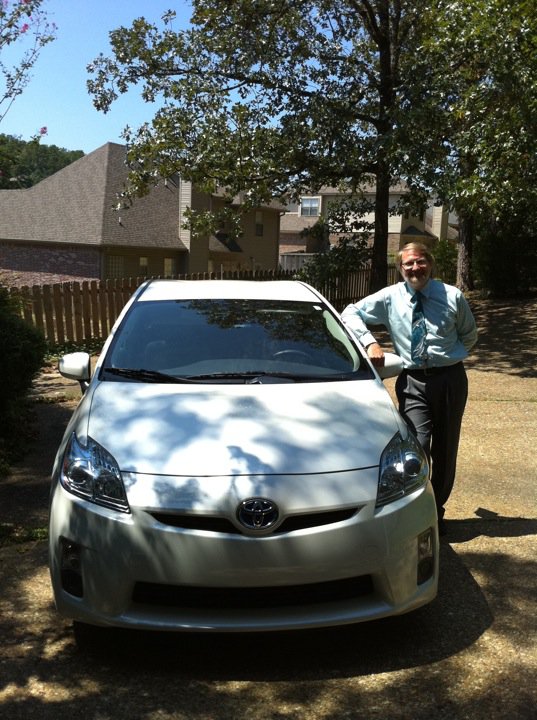
I bought a used 2010 Prius just a few weeks ago. It’s white and shaped like an egg, and I’ve already begun thinking of “The Egg” as a nickname for it.

Don’t misunderstand; I love my new car. I’ve wanted an electric car since my environmentally-conscious teenage years in the 1970s, and a hybrid is the next-best (affordable) thing right now.

But I’ve already learned some disturbing things about myself just driving it these last few weeks.

  • I have tended to rocket between stop signs in my pre-Prius years. Not just on the road, but in life. Perking along in The Egg – with an eye to the “ECO Mode” readout on the dash – I’ve learned that easing up to the speed limit and sticking to it gives me time to actually see where I’m going, as well as watch it. This is a good thing, since I had to buy a car to replace the nine-year-old minivan that I wrecked while not paying full attention to where I was going. And I have time to think about where I’m going in life, too … drive time is a good time to reflect on that. Life should be a journey as well as a destination. Getting there should be half the fun.
  • I have also tended to take unnecessary risks to get ahead. Yes, also not just on the road, but in life. Shrieking tires to gun out ahead of someone else is really difficult to do in a Prius (0-60 in 11.9 seconds – not exactly comparable to a Lotus). I’ve had cause to think about just why it is important for me to get ahead in the first place. When it’s not a possibility, I don’t have to uncork the adrenaline worrying about doing it, and I am a less-stressed, safer person to be around. In many ways. All I have to do to quell the temptation to take a foolish risk while driving is to picture a scrambled Egg.
  • I’ve wasted a lot of fuel – and money to pay for it – without really needing to, in the past. (Okay, no unkind remarks about my expanding midsection, please. But I am no longer going to shrug that off by remarking, “I’m just growing as a person.”) I rough-calculated this morning that if I continue to get twice the gas mileage with the Prius that I got with my old car, drive about the same number of miles, and keep it a little longer – say, ten years – and if gas prices remain steady, I will have saved about half the cost of my car in fuel expenses. If gas prices go up, I will of course have saved more – or that amount sooner.
  • I am addicted to comfort. My Prius is heavy for its size (two engines; big battery array) and gives a great ride; it has a very ergonomic interior, soft (heated) leather seats, an adjustable temperature setting that I can set with buttons on the steering wheel, bluetooth access to my cellphone with an answering button on the steering wheel … the options list goes on and on. I didn’t have any of that stuff in my old car, and I would miss it badly if I had to go back. It’s excessive. I had no intention of spending as much as I did – or even buying a Prius this new – but I had no objection when it was the one Angi really liked.
  • Jesus would probably not drive a Prius. Okay, this is just purely speculative. My car has some good points, and it may be more economical and in some ways environmentally-friendly than many of its companions on the road, but there are still some realities to face. At the end of its lifetime, I will probably have to pay a fee to dispose of that battery array. It still uses a (low-emissions) gasoline engine, which produces unfriendly hydrocarbons, and consumes petroleum as fuel. But far beyond those concerns – which might or might not concern the Savior – it isn’t walking. Jesus walked. A lot. It put Him among people; people who needed His touch in their lives. So I’m planning to walk more. I can walk at lunch time; there are plenty of nearby eateries where I can hold doors for fellow diners, smile, engage in conversations that almost always will include where I work (at my church) and possibly why.

Well, that’s just a little sample of what I’ve learned about me while driving The Egg.

I think it’s helping me approach life with an attitude that’s a little less hard-boiled.

Blogging Sabbatical

After a 25-year absence, my carpal tunnel syndrome has returned with a vengeance – and this time in both arms.

So I’m cutting way back on my tweeting, facebooking and blogging.

I can just about get through a normal day’s work at the keyboard without hitting my pain tolerance limit, and that means limiting my extracurricular keyboarding and even my detail-intensive model railroading.

I’m also in a holding pattern for a couple of weeks while some blood tests and an EEG are analyzed after a bit of an episode several weeks ago in which my left arm/hand and left foot/calf started to swell, turn blue, experience intense pain, and then just as suddenly returned to normal a few minutes later. I was a bit disoriented – not thinking at my best – and instead of going to a doctor, napped it off.

I’m hoping it was a one-time thing, and nothing serious.

And that I can get back to my social nit-witting soon.

Speaking for God

“We speak where the Bible speaks, and are silent where the Bible is silent.” ~ unofficial motto of (most) churches of Christ.

“Lord, fill my mouth with worthwhile stuff – and nudge me when I’ve said enough!” ~ prayer of the probably mythical old preacher

“If anyone speaks, he should do it as one speaking the very words of God.” ~ 1 Peter 4:11a

Isn’t this one of the heaviest burdens carried by those who truly desire to speak for the Lord? Whether preaching, teaching, writing a blog, or just conversing about matters religious with a friend?

How do we know when we’ve stopped speaking for Him and started rattling off our own perceptions about what He’s said?

Isn’t it pretty important to stick to what He’s said?

And after all, aren’t there plenty of powerful speakers with advanced degrees in biblical studies who don’t agree on what He’s said?

I wonder from time to time if this doubt isn’t one of the most powerful tools Satan has in shutting us up about the Savior. I wonder if it’s one of the un-discussed root causes for preacher burnout and parishoner abandonment of evangelism.

I wonder if we’ve made the gospel more complex than it is.

Would you like to know what gives me hope when I try to write or speak on the Lord’s behalf – however imperfectly, humbly, and haltingly?

“Therefore I tell you that no one who is speaking by the Spirit of God says, ‘Jesus be cursed,’ and no one can say, ‘Jesus is Lord,’ except by the Holy Spirit.” ~ 1 Corinthians 12:3

“Then Peter, filled with the Holy Spirit, said to them: ‘Rulers and elders of the people!'” ~ Acts 4:8

” … for it will not be you speaking, but the Spirit of your Father speaking through you.” ~ Matthew 10:20

The Spirit of our Father speaks through us. We just leave it to Him. It happened just as Jesus described it to His followers. And Paul writes to Corinth that it still works that way. It’s a simple message (“Jesus is Lord!”), delivered in a simple manner, through simple people like you and me. No advanced degrees required; just the Holy Spirit speaking through us.

And all we need do is ask for His help.

“If you then, though you are evil, know how to give good gifts to your children, how much more will your Father in heaven give the Holy Spirit to those who ask him!” ~ Luke 11:13

You can even ask for that help to be given to others:

“I keep asking that the God of our Lord Jesus Christ, the glorious Father, may give you the Spirit of wisdom and revelation, so that you may know him better.” ~ Ephesians 1:17

“For this reason, since the day we heard about you, we have not stopped praying for you and asking God to fill you with the knowledge of his will through all spiritual wisdom and understanding.” ~ Colossians 1:9

I have resolved to take a new approach when disagreeing with others about scripture, or when trying to argue toward a common understanding of God’s message, or whenever I feel compelled to speak for God. I’ve resolved to pray for the Holy Spirit’s discernment for all parties involved, including (especially!) myself.

I can be as opinionated and pig-headed and closed-minded as anyone else I know. I need to be more open-minded … no; not so much that my brains fall out, but so much that His Spirit can fall upon me. I need to make room for God’s understanding, even if it pushes my understanding out through my nose and ears.

So I’m asking you to pray the same thing for me.

Glimpses

That’s all we get from scripture of the heavenly realms of eternity.

Snapshots. Out-of-focus. Overexposed. Short on detail, usually.

An inspired yet nameless poet puts words to indescribable chaos, creation and glory while penning the opening chapters of Genesis, but aside from His Spirit hovering over the void, God later walks in the cool of the garden. It’s paradise that He’s created. But it’s not heaven. When a choice for self and now and evil is made, man and paradise must go separate ways.

The unknown writer of Job 1-2 describes a heaven where Satan still has to check in with God. Though people talk about “God showing up” in their church these days, it ain’t nothin’ like what Job experiences in those final chapters.

A few spare words of prophecy in Isaiah 30:27-33 and 31:8 spell doom for Assyria in what seems to be a fiery, cacophonous, cataclysmic battle. In heavenly realms, perhaps it is. But the reality on earth is much more quiet: In one night, one angel obliterates 185,000 Assyrian troops (Isaiah 37:36; 2 Kings 19:35).

In Daniel 10, the prophet learns why his prayers haven’t been answered for three weeks. There’s a battle going on that has detained the heavenly messenger to the prophet, and it’s not immediately clear where it’s taking place – but if a divine prince named Michael had not intervened, the delay might have been longer.

The whole account of battle in heaven and on earth, of judgment and the descent of the heavenly Jerusalem in the Revelation to John is filled with imagery that defies any artist to master.

But all we get are glimpses. – And a deep conviction of one fact that no one can deny:

Things are very different there.

There’s a conflict in the divine realm that has a very definite ending, an ending predetermined since the beginning of eternity (if there is such a thing): Evil is destroyed. Good is forever enshrined. God is eternally enthroned.

And people who choose to be good; to be like God – those who do right and wash their robes (Revelation 22:10-15) – have a dwelling with Him there, and continue to serve there as His servants (22:3-5), reigning with Him forever and ever.

All they need do is hear, and thirst, and wish, and take the free water of life (22:17).

Paradise is restored.

But some may object that hearing, thirsting, wishing and taking the water of life is no real plan of salvation in this world. It isn’t the right set of steps we must take. Not literally. Maybe metaphorically, in those heavenly realms.

I have to wonder if we’re missing a great truth by ignoring the metaphor, though, if that’s all it is. I have to wonder if we’re missing even more by thinking of it only as a metaphor and not a heavenly reality. I have to think that the original listeners to the gospel of great hope shared in the Revelation were thinking of the prophecies they grew up hearing and the stories they heard later; stories of Jesus hinting that He fulfilled those prophecies.

Prophecies and stories like the lamb and the lion (Isaiah 11:6, 53:7; 65:25; John 1:29-36; Revelation 5:5-13 – where a kingly Lion of Judah is announced, but a sacrificial Lamb appears).

Prophecies and stories of a holy city (Nehemiah 11:1; Isaiah 52:1; Matthew 4:5; Revelation 21).

Prophecies and stories about living water (Jeremiah 2:13, 7:13; Zechariah 14:8; John 4:10-11, 7:38; and Revelation 7:17).

Prophecies and stories of a tree of life (Genesis 2:9-3:24; Psalm 1:1-3; Proverbs 11:30; Revelation 2:7; 21:2-10 and 22:19).

And of a choice that must be made, between the prince of the world that cannot last, and the Prince of the Realm that cannot end. Did you notice? Jesus stands astride them both, bridging the gap between, man-who-is-God and God-who-is-man. Yet only one realm has a future.

Glimpses. Foreshadowings. Hints and peeks and promises … that things are very different there.

More real than the tangible reality we know here. More permanent than the temporal instant we experience now. More vast than space. More lasting than time.

Glimpses are all we can get. Choices are all we can make.

From start to finish, the people God created must choose: Tree of shortcut, or tree of life. Now, or forever. Thirst, or water. Darkness, or light. Self, or Him. Good, or evil.

What we do reflects what we have chosen by faith in His grace. So we are judged by the Lord (Revelation 22:12, 14), the only One capable of judging us by virtue of His all-encompassing, eternal nature (13).

However, time is short:

Then he told me, “Do not seal up the words of the prophecy of this book, because the time is near. Let him who does wrong continue to do wrong; let him who is vile continue to be vile; let him who does right continue to do right; and let him who is holy continue to be holy.” ~ Revelation 22:10-11

And the choice is upon us all.

Other Fellowships’ Phrases

We avoid them like the plague, don’t we?

Which makes me wonder if there are Restoration Movement Christians who have been baptized by immersion, but have never really asked Jesus into their hearts … because that was some other fellowship’s phrase.

Of course, it’s also Paul’s phrase (Ephesians 3:17), and what Jesus encourages us to do (Luke 11:13).

And I wonder if there are Christians who have asked Jesus into their hearts, but have never been immersed into His life – as well as His death, burial and resurrection in baptism.

Those are phrases of Paul, too (Romans 6:1-6).

I wonder, also, if there are those who are saved, but have never heard a heavenly calling to a holy life; to God’s purpose (2 Timothy 1:9; Ephesians 4:1; Hebrews 3:1; 2 Peter 1:10) – because those phrases just aren’t in their vocabulary.

I have to wonder if there are followers of Christ who wouldn’t know what to do if a word from the Lord came to them (Jeremiah 37:17; 1 Samuel 15:10), or felt a burden God had laid on them (Ecclesiastes 3:10; Matthew 11:30), or were moved to participate in a sinner’s prayer (James 5:15-16) – for the reason that these phrases just aren’t written in their book.

Or they are written there, but they haven’t seen them for what they are.

I wonder if the proprietary phrases indicate our willingness to see and follow only part of God’s entire purpose for us; if they betray our unwillingness to see and be blessed by a whole gospel and a full fellowship. I wonder if these shibboleths serve to separate us, keep us apart, prevent the blessing of unity in the Spirit and the bond of peace between Christians who each adhere to his/her own distinct doctrines and subcultures and groups and sects and cliques and lingo and phrases.

Most of all, I wonder if I’m one of them.