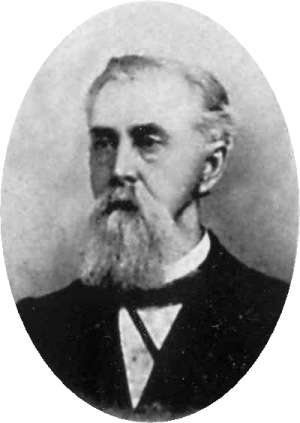
 I’m coming to terms with my heritage in Churches of Christ through the person of my great-great grandfather Alfred Ellmore, one of the early preachers in the Restoration Movement that yielded this fellowship. This is an installment from his 1914 book Sermons and Chimes, and my reactions to it in the form of a dialogue with him:
SERMONS
THE ARK AND THE CHURCH
“And God said unto Noah, The end of all flesh is come before me, for the earth is filled with violence through them, and behold I will destroy them, with the earth. Make thee an Ark of gopher wood, rooms shalt thou make in the Ark, and pitch it within and without with pitch.” (Gen. 6.)
If a man who had never heard of the Bible were given the Old Testament to itself, he would be surprised at the many wonderful things he had read, but he would also be surprised at not finding the object of his search. He had been told that there was a golden thread running entirely through the book, promising the world a great king, a deliverer, and a conqueror — ah! a Savior — but having read the book through, he found the history of many great men, but the great one promised he found not.
But if he were given a copy of the New Testament, having never seen nor heard of the Old Testament, he would find at its beginning, and running all the way through the book: “It is written, it is written in the law, it is written in the prophets, it is written in the psalms,” etc., and he would wonder who wrote those books, and where he could find them.
One of the many strong evidences that the Bible is divine, is its types and its anti-types. The Old Testament abounds with shadows, the full meaning of which would never have been known, if the New Testament had not been written. For example, what would the world know of the deeper meaning of the opening of the side of Adam, and the means taken therefrom to form for him a wife, if the side of Christ had not been pierced and the elements been taken therefrom — the water and the blood — to form and cleanse for him a bride, the church? God has given the world but two lawgivers, Moses and Christ, and we should never have had the deeper meaning of the finding of the former in the little basket in the rushes, if we had not heard of the finding of the infant Christ in the manger! And the world would never have seen the deeper signification of Adam and his one wife being required to populate the whole world with his offspring, if we had never heard of the wonderful transaction of Christ, through his one wife, the church, populating the whole world with Christians.
Great-great Grandfather, the metaphor of the bride being made from the side of the first Adam and the last Adam (as Paul phrases it in 1 Corinthians 15:45) is deep and visceral and invaluable. Thank you for that.
A few of the many types of Christ, are Adam, Moses and Isaac. Adam, the progenitor of the human race, foreshadowing that Christ would bless the world, the whole world, through a spiritual family which he would bring forth. Moses leading fleshly Israel from Egypt to Canaan, through the wilderness, foreshadowing that Christ would lead the spiritual hosts through this world of sin, to the land of rest. Isaac being made a sacrifice, in a figure, was the type of Christ, who was made the atoning sacrifice of the world. A few of the chief types of the church are the Ark, the Tabernacle and the Temple. And when these types are deeply studied and their corresponding anti-types in the New Testament are found and fitted, and a few prophecies added from the Old Testament, they form a bulwark of testimony that men and demons can not shake.
But I beg leave to deviate for just a few minutes, to adduce a golden thread as evidence from the work of Moses. Moses rose up 2,200 years this side of creation, and without a word of written history, in a few brief chapters covered that period perfectly and accurately. Then he went upon the mountain and received the law of ten commands, which he delivered to the people of God. Then he became prophet, and covered 1,800 years with a few prophecies, reaching to the coming of Christ, hence this man Moses, whose flaming words Ingersoll and a few lesser lights delight to mar and stain, became historian, lawgiver and prophet, and covered a period of 4,000 years, and he has never made one mistake that any one knows of. And how could he, with no date written, give an accurate history of 2,200 years? And how could he look down th[r]ough the ages and give accurate prophecies which are indorsed [sp.] by the later prophets, by the Savior and the apostles, if he had been only man? No wonder that Ingersoll, at death, cowered when considering his tare-sowing, and looking into the future, realized that he must reap as he had sown. What a future he will meet. Josh Billings, the humorist, gives my sentiments when contrasting Moses and Ingersoll. He says: “I wouldn’t give five cents to hear Ingersoll on the mistakes of Moses, but I would give five hundred dollars to hear Moses on the mistakes of Ingersoll.”
As an illustration from type and anti-type, take the following: Some morning in autumn a farmer goes into his field and sees his shocks torn, and there are tracks in the soft soil, such as he has never before seen. On looking to the east he sees the fence is broken down, and also upon the west. His conclusion is that some wild beast has done the damage. He tells his neighbors of his loss, and they say: “Perhaps it was a cow that has broken into your field.” “Oh, no, I know it was not a cow.” “But did you see the animal or see any one who did see it?” “No.” “Then how can you be so positive that the animal was not a cow?” “I know it by the track left in the soil.” Calling in some of the neighbors, and all deciding that the animal was a foreigner, they decided to call a man who was a great hunter, who had seen all kinds of animals on the American continent, who, when he saw the track says: “That is the track of a black bear! Sure, ask a number.” “May it not have been a grizzly or a mountain lion?” “No, sirs.” “Not having seen the animal, how can you be so positive as to the kind of a bear?” “I identify it by the extra toe in the track.” Now if this hunter is not mistaken as to the track, you are sure there is a black bear roaming somewhere in the community. There is no other animal known which makes such a track.
Dear ancestor, in your era the debate over inspiration may have been so well known that your listener / reader could discern your intent and easily deduce your support of the Holy Spirit’s role in bringing about the scriptures. But those of us in later days — and even disinterested unbelievers of your time — might have benefited from a clear statement of it.
In Noah’s time, the world having become desperately wicked, and every imagination of the thoughts of his [man’s] heart was only evil continually, and refusing to hear the counsel of God, he concluded to destroy them, and said to Noah: “I will destroy the world with a flood; make thee an ark to the saving of yourself and your house.”
1. Now what was the object of the Ark? Salvation from death. From what death? Physical death. Physical death by what means? By drowning. And if there had been no flood, there would have been no need of an Ark. Where no loss is involved, there can be no salvation. This is true of every salvation spoken in the Bible. There could be no salvation from the grave if there had been no grave, and no salvation from sin if there had been no sin, and there can be no salvation from hell if there is no hell. The loss of the antediluvians may reach further than physical death, but this is the salvation promised by means of the Ark.
Now, let us take a view of the church. Christ said: “I will build my church.” Christ is the head of this body, and no man can come to the Father but by him. To him be glory in the church, by Christ Jesus throughout all ages, world without end. But some say the church can’t save us. But did the Ark save? Yes, those who went into it, and remained until the flood was over. And I think there is one class whom the church can save, those who go into it, remain in it, and do their duty.
There is a problem with this metaphor — that of the ark as type and church as antitype — and that is, of course, it is not strictly scriptural. It’s one that you, Great-great Grandfather, have devised. While it may be illustrative, it is not what one would call authoritative. That’s the purpose of a metaphor or parable: to clarify, rather than justify. They make truth clear; they do not make truth true.
When Peter speaks of Noah and salvation (1 Peter 3:19-22), he’s talking about how the resurrection of Christ pioneers the way for our own; how the waters of baptism wash away the world’s sin as the waters of the flood did so in Noah’s day. It is a chapter about imitating Christ, even through suffering as He did. The church — strictly speaking — can’t save us; we are saved into it. We could vote each other in and out all we want, but it would not save anyone.
2. How many Arks did Noah build? Only one. But since there were a great many people, why not make several Arks? And you know “all people can’t see alike,” and one Ark might not have suited all, with so many tastes and notions. And some might no like old Noah, he was a pessimist, clear and simple, no way would do but his way. And some of the women might not like some of Noah’s family. No, we can never join such a crowd as that! And I have no doubt but if we had a history of the suggestions made by men to Noah’s sons, and made by women to the sons’ wives, we would have something like the following: “Your father is old and he is becoming childish; we hardly think there will be a flood — it has never rained, and there is not sufficient water in all the seas and oceans to cover all these mountains; and why require Noah to labor more than one hundred years to build an Ark? And if he must bring a flood, he can point out to Noah the highest mountain and have him collect all the required creatures to that mountain, and take there of all food and preserve life as well there as in an Ark, wich would become musty and very unpleasant, and saved your father all this work? And if none are saved except those in the Ark, there will be very few saved.” And the women would approach the three wives of these three sons and suggest: “Now your father is a good man, but he is narrow in his views, and thinks nobody right but those who believe as he believes, and by his rigid preaching he has become very unpopular. Now, have the old man to exercise charity for the views of others, there are others who are as good as yourselves.”
Great-great Grandfather, I think you may have been as much a fan of Mark Twain as I am.
Then we might hear something like the following from the faithful old Patriarch: “Dear daughters, I would be glad to please all, and would be far from preaching a doctrine purposely to displease any one, but I have a message, not from man, but from God, and if I refuse — nay, fail — to deliver that messages, strictly and perfectly, to the minutest detail, we will all go down into the dark waters of inconsolable grief, with the rest of the disobedient.”
And how many churches did Christ build? But one. The church is the Bride, the Lamb’s wife, and we can not think Christ was a polygamist. The word “church” is in the singular, except when various congregations are meant; the seven churches of Asia mean simply, the seven congregations. The followers of Christ are commanded to be of one heart and of one soul, to speak the same things, and there must be no division among them.
3. The Ark was 450 feet long, 75 feet wide, and 45 feet in height, and had three stories, and yet it had but one door, which was in the side, and everything that went into the Ark went in through that one door. There was not one door for the admission of the large animals and one for the small animals, and another for the birds. Jesus says of the door into his church: “I am the door.” Then we must go in through Him. And when the side of Jesus was opened thence forth came the water and blood, the cleansing elements from sin, and no man can get into His church except through the water and the blood. We are immersed in water, into Christ’s death, and there we come in contact with His blood, and we are washed, cleansed and saved.
I have written before about the phrase “come in contact with His blood,” and since writing then (I Can’t Find It), I still have found no preponderance of evidence for saying it.
4. There was but one window in the Ark, and that was above, or upon the top, and here we see the sideom in so arranging the light. If the window had been near the base the heavy freightage would have kept it inundated, or if half way up, the spray and the waves would have darkened the window much of the time. But being upon the top, all the light possible could flow into it. And when we come to consider the light brought into the church, it all comes in through the one window. And what is that light? Some say it is conscience. No, if this be the light, then we would have as many windows as people, and no individual would give light to another.
But another says it is the Baptism of the Holy Spirit. No, the gospel was often preached by the apostles, and people were saved, in the absence of the Baptism of the Holy Spirit. The Baptism of the Holy Spirit never converted any one, was not given as a condition to pardon. The Baptism of the Holy Spirit fell upon men to enable them to work miracles, and this occurred but twice, once upon the Jew and once upon the Gentile, and following this miraculous power men were baptized in water for the remission of their sins. (Acts 2 and 10.)
“But twice”? Then, dear ancestor, you would write off Acts 19:11, 1 Corinthians 12 and 1 Corinthians 14, 2 Corinthians 12:12, Galatians 3:5, and Hebrews 2:4? You know, there is such a thing as pushing a metaphor too far.
Clearly, then, it is the Bible which brings the light from heaven. Where this revelation has never been given, people are in darkness, but where delivered and accepted, the inhabitants become enlightened and rejoice in this heavenly light.
5. All the food was in the Ark. The command to Noah was: “And take thou unto thee of all food that is eaten, and gather it to thee, and it shall be for food for thee and for them. Thus did Noah, according to all that God commanded him, so did he.” After the waters covered the earth there was no food for man, beast nor fowl.
But now men have become wise. One church, one assembly, one altar, is not sufficient. It has become necessary to have in addition to this perfect Holy Place, a separate gathering for the young men, another for the young women, another for the young people, and still another for the children! But look here, my zealous but misguided brother. Christ has but one body, and in this divine body — the church — dwells the Holy Spirit, in this one body is the blood, which remains in this body. And the grace of God, all of it, comes to the Christian through this divine medium. And every parable spoken by Christ where a blessing is conferred, it is within, and not without. And he formed the parables from things with which they were familiar, that the most unlearned could grasp his meaning. It was in the net that the fishes were caught, in the vineyard that the laborers must work, in the meal the leaven was placed, in the field that the seed was sown, in the field was found the pearl of great price, in the garden the mustard was sown, in the field the treasure was found. Let us be careful, very careful, that we do not direct some soul astray.
And here, I would say, is where the metaphor is taken too far — in the direction of painting the church as a place, rather than as a people. The wooden ark surely makes a fine metaphor to a wooden church building as typical of your day, but it is not an accurate metaphor in that way. Thinking of the church as a single edifice has led many to conclude that people meeting in a different building from their own cannot be a part of their church, and that is simply erroneous. When we so judge, we are judging, and that is not our place. Our place is to love, accept, and share the gospel — and to maintain the unity of the Spirit in the bond of peace.
6. There was one family in the Ark, and they must eat and drink to perpetuate life. If one had decided to fast during their stay in the Ark, he would have fasted longer than Dr. Tanner fasted. They were in the Ark a year and ten days. They went into the Ark on the seventeenth day of the second month in the six hundredth year of Noah (Gen. 7:11-13.). and they went forth out of the Ark upon the twenty-seventh day of the second month in the six hundred and first year of Noah (Gen. 8:13). During that period, in the one Ark, the one family prayed at the one altar, and ate at the one table. And we can not satisfy the longings of the soul at heathen altars nor gluttonous feasts.
7. The conditions of salvation by means of the Ark and of the church are the same. The first thing necessary in Noah’s case was a revelation. If God had not made known to him the coming destruction, Noah would have known nothing of it, and would have made no preparation for his salvation. After being informed of the approaching flood and of the terms of salvation, Noah must believe the revelation. The next thing was works, faithful works, complying with the terms offering salvation. He must build the Ark, go into it and remain, and be faithful to all the duties incumbent upon him as governor of that divine family. So in the salvation proposed in the church. As to the means of transition, bearing Noah’s family from the old world over into the new world, Peter says: “Wherein few, that is eight, souls were saved by water, the like figure wherein baptism doth now save us.” (1. Peter 3.) The water picked them up, and by means of the Ark, they were carried over and put down into the new world, so baptism takes the subject from the kingdom of sin and puts him into Christ, his church. He is then born again, born of God, born of water, born of the spirit, born (begotten) of the word, born anew, taken from the world and put into the church — saved. And the man of a very common intellect would say the birth was not of water alone. But some of the “called and sent” clergy now tell the people that baptism has nothing to do in saving men.
Baptism has much to do with saving men — but it is not the only thing God wants for us, and gives us, and wants to bless us with that is salvific; of His saving grace and power. Seeing baptism as a work of man — like building an ark — is an error that has seduced millions. Jesus built the church; not us (Matthew 16:18). And baptism is a gift from God (Matthew 21:25); ours to accept or reject. But in rejecting baptism, we reject its power of testimony to one’s immersion into the life of Christ and resurrection from one’s old dead person of sin.
8. I will now touch upon the destruction which followed the dispensation of God’s mercy, which lasted over one hundred years, but my pen is too feeble to portray that awful catastrophe. No heart can conceive, nor tongue describe, the horrors which fell upon that disobedient people. The Ark being finished, and the creatures all shut in, the windows of heaven were opened and for forty days and forty nights the waters fell in torrents, the low lands were covered, people’s hearts were faiting, they were being forced out of their homes. God is infinite in mercy. Many as devout prayers as were ever heard were offered, but the rains continued. People go up the hillsides. They were drenched and hungry. Children cried for bread. God is infinite in love! He loved all these people, but a God possessed of all the attributes can’t save people in disobedience. Poor old grandma’s strength had failed, and she had to be carried. O the cries and lamentations! Where are the children? Some had starved, some had fallen into the dark sea. God was able.
But see that group upon the highest hill; their provisions are exhausted, and they are ankle deep in water. God had said if they did not repent he would drown them; it looked that way then; they make their last appeal for help. God is infinite in all his attributes, and one of them is justice, and he will render to every man according to his works. Another is vengeance, and he will punish all who trample his righteous laws. If God had commanded Noah just then, saying, “They have suffered enough, push the Ark to those people and take them in,” would it have required a strong discourse, and a touching exhortation to induce them to enter the Ark? But it was too late — ah! too late.
But, my slothful brother and my heedless neighbor, let me once more remind you of that awful destruction, more fierce that this one, which I believe will fall upon the world in the near future. Peter says: “The world which then was being overflowed with water perished. But the heavens that are now, and the earth, by the same word are stored up for fire, being reserved against the day of judgment and destruction of ungodly men.” [2 Peter 3:6-7] He says: “The elements will melt with fervent heat, the earth and the works that are therein shall be burned up.” [2 Peter 3:10] Now, sinner, do you not believe this? Then eternal fire awaits you. But we, according to his promise, look for new heavens and a new earth wherein dwelleth righteousness. O that great day. We shall all be there.
There may have been a time when addressing one’s listeners and readers as “slothful” and “heedless” had an air of authority to them, but these days, insults simply come off as insulting. (I have to wonder if they did back in your day, too, Great-great Grandfather.) At any rate, I cannot recommend the use of them.
In fact, I have to question the whole psychology of pointing an accusing finger down from the pulpit of authority … trying to terrify someone out of hell and into doing a bunch of things that leads to trying to always do the right thing … lest one slide right back down a hell-bound slope. Does that really lead a person to become a devoted, life-long disciple and example of Christ? Fear?
Or does perfect love cast out fear? Doesn’t it make more sense to come alongside someone whose life-path wanders aimlessly … lovingly share the message of the dying-yet-living love of Christ with them … and teach them what it means to be like Him so that others can see His promise in our lives?